Overseas Investment Properties & Depreciation

Whilst it’s certainly not the sort of reports we target, a number of our clients own investment properties overseas. If you’re claiming the rental income in Australia, then you’re entitled to minimise your tax via having a depreciation schedule completed.

To date we’ve completed many reports for overseas investors in places like the United States, United Kingdom, Malaysia, India, New Zealand and more.

How do we do it?

Essentially, it all boils down to accurately estimating the costs. We’re experts in depreciation legislation in Australia of course, and also construction cost estimating across Australia. It’s important to remember that construction costs vary across Australia’s capital cities and regional areas. In fact, it’s 80% more expensive to build in Weipa (far north Queensland) than it is in Brisbane. The index is in Australia is based on the capital city of each state. So in Queensland it’s Brisbane with an index of 100, and Weipa has a regional index of 180.

When estimating construction costs overseas we need to consider the following;

  • Typical construction costs in the closest capital or major city
  • The regional index of the place we’re estimating (i.e. Jaipr vs New Delhi)
  • The changes in construction cost over time (i.e. it was cheaper to build 2 years ago than it is today)
  • The currency conversion rate
  • The historical currency conversion rate at the time of construction


There’s a few tricks we have up our sleeve to find this information, but once we know the cost to construct in a particular city today, we’ll do the following:

  • Apply any applicable regional index
  • Apply local building price indices (these track the movements of costs over time)
  • Apply historical currency conversion rate (from Euro’s to AUD for example)

Whilst all of our investor clients with properties in Australia will have their properties inspected by a member of the MCG team, overseas properties are not inspected in the same way.

The best information we can receive is floor plans, specifications lists and even actual costs when available. We’ve also pioneered a checklist which walks our on site contacts through the process of measurement, asset identification and cataloguing that enables us to complete the inspection remotely, often carried out by a property professional on the ground or the client themselves. I must assert however, that this remote method is never as good as actually being on the ground ourselves. Our staff are trained to detect improvements, renovations, plant assets and identify variations in the age of both building and plant components. We strongly advocate that properties within Australia do not have their depreciation calculated in this way. Additionally, if the information we receive is not up to scratch, we’ll keep working with the contact until we get exactly what we need prior to completing a report.

It boils down to the best possible method of capturing the specifics of the building overseas. As much as we’d love to travel overseas to inspect these properties ourselves, our clients wouldn’t not be pleased with a bill for overseas travel! It’s certainly too cost prohibitive.

However, when it is possible, it’s certainly a great way for investors to maximise their cash flow. In fact, our last overseas client achieved over $8,000 worth of depreciation on their home in Scotland. We’ll worth the effort if having a report done.

Unit Renovation Case Study

Our latest case study is a cracker. It showcases what can be done within a small space and smashes a commonly held myth that a property built before 1987 will never have any depreciation deductions.

The unit was in Mona Vale, in Sydney’s beautiful northern beaches. It is a two bedroom, one-bathroom unit in a three level building complex built in the late 60s. As far as common area assets, there was next to nothing to claim, a few door closers, light shades and such. Here are a couple of before shots of the unit.

Kitchen Renovation 300x200 - MCG Quantity Surveyors

Kitchen Renovation Tax MCG 300x200 - MCG Quantity Surveyors

The total value of the work was just over $120,000 and included the following plant and equipment assets such as floor coverings, window furnishings, kitchen appliances and some furniture items.

We’re often asked on the phone what the potential depreciation deductions might be for a property based on say a 50k renovation, or a 150k renovation. There’s no magic formula, but we do know that so long as there are no non-depreciable components such as soft landscaping, the absolutely minimum rate of depreciation for qualifying renovations is 2.5% of the value each financial year for 40 years. So it’s impossible to get less than $2,500 per year of deductions on a 100k renovation. But that’s never going to be the true value of the deductions. With every major renovation, we’re going to see new plant and equipment items like carpets, blinds, ovens and so on. All of these assets are considered to have lesser effective lives than the building structure, which affects their rate of depreciation. For example, carpet will generally depreciate at 20% depending on its value, and other assets as high as 40%. We’re also going to see assets qualify for an immediate write-off.

So using this case study of say 120k, we know that the minimum has to be $3,000 per year. As a rough guide, we can usually triple that figure in the first year if we know the kitchen and the bathroom were renovated.

What did this unit achieve? Well in the first full year of claim we found $14,505 worth of depreciation deductions, and over $10,000 in the second year. A pretty solid result from a depreciation standpoint. More importantly though, how does it look?

The unit transformation was undertaken by Belinda at BG Property Styling.

Investing with Super – Commercial Offices & Depreciation

According to the Australian Tax Office, close to 600,000 self-managed super funds are now in operation. Hardly surprising given the fairly ordinary results of retail super funds, the fallout from the GFC and the relaxation of SMSF rules in Australia.

Clients purchasing property within their super fund are entitled to claim depreciation deductions, and we’re completing more and more of these reports each day. A common trend we’re seeing is for business owners to purchase the building their business occupies as a tenant. It can be a great strategy from a security of location standpoint as well as capital growth.

It’s important that clients understand that this income producing property is entitled to claim depreciation, and regardless of the rate of tax (normally 15 or 30%), the result of a depreciation schedule can be significant.

For example, we recently completed a report for a Super Fund, engaged by a client who bought two adjoining strata units within a small complex in Narellan, NSW.

Whilst the units were fairly small, the complex was constructed in June 2000 and the clients had undertaken a fitout to the tune of around $163,000.

As the units belonged to a strata titled complex, the super fund had an entitlement to claim a share of the common areas, as well as plant items such as Fire Extinguishers, Door Closers, Lighting and more. The common property share of deductions was around $1,400 a year worth of deductions on its own.

The fitout included assets such as new air conditioning, carpet and vinyl, lighting, security, fire alarms and window blinds. However, the majority of the fitout value was capital works which features a lesser depreciation rate of 2.5% per year, rather than plant assets ranging from 100% to 10% in this property. Capital works within a commercial office includes the structure itself and things like fixed cabinetry, ceiling tiles, gyprock and the like.

The net result of the combination of these assets equated to over $297,000 worth of total depreciation and over $16,700 worth of deductions within the first full financial year.

Whilst it’s easy to write about fantastic examples achieving super deductions, this property was a fairly modest and typical commercial office purchased by a super fund. Luckily the clients’ accountant ensured that a depreciation schedule was sought and we were able to find these savings.

Scrapping Schedules Demystified

Scrapping depreciable assets is a fantastic way to claim deductions as an asset reaches the end of its practical use. Essentially it’s a simple process but we’ve had a number of calls from investors confused by terms like ‘scrapping schedules’. The difference between a depreciation schedule and a scrapping schedule is practically nothing, other than the fact that a scrapping schedule may only include assets that have been, or will be thrown away. In essence, if you’ve been renting your property for a while and decide to throw away something like the carpet in favour of an upgrade, you can claim the residual value of the carpet as a 100% deduction. In other words, if the carpet was worth $800 at the time it was thrown in the bin, it means you’re able to take $800 off your taxable income in the year in which the carpet was disposed of. There are certainly some nuances to scrapping, but it’s a fairly straightforward process.

Some companies are suggesting that you need a standalone scrapping report, and a separate report once the renovations have been completed. Whilst this might be the easiest way to approach the deductions, it may not be the most cost effective method, nor even necessary. Each case is different but it’s important to understand that any schedule can in theory become a scrapping schedule if you’ve decided to dispose of all of your plant and equipment assets.

Without going into too much detail, there are two important things to consider;

  1. The asset can no longer be used. In riveting ATO speak this means;

“Once a taxpayer has scrapped or abandoned an asset, there is a presumption it can no longer be used by anyone for the relevant purposes. The scrapping of an asset demonstrates that the asset is either physically exhausted or obsolete. A taxpayer may abandon an asset if it is too difficult or costly to remove it from its place of operation.”

For example, you cannot remove a hot water system from an investment property, claim the residual value (scrapping value), and then install the hot water system in a new investment property and continue to claim the depreciation as normal.

  1. In a newly purchased investment property, there must be an intention to rent the property as is.

In other words, the ATO states that purchasing an investment property with the intention to renovate it immediately and dispose of the assets, does not fit their criteria for being eligible for scrapping deductions. If you purchased an older property and rented it out for say 12 months, then decide to renovate, this is a different matter and would allow you to claim 100% of the residual asset value of items that have been thrown away due to obsolescence, i.e. ‘scrap’ them.

To take a look at what scrapping can mean for your deductions in real terms, take a look at the analysis in this table featured here http://bit.ly/1k8WKRK which shows the scrapped values and the deductions associated with the replacement assets as well. If you have any questions, we’re always happy to assist!

Sydney leading the charge as dwelling values rise in May

Whilst month on month figures are a little haphazard, the last quarter has seen Sydney prices grow by 6.6% with Perth and Hobart the only capitals in negative territory.

Ssss 300x143 - MCG Quantity Surveyors

Our current property growth cycle comes to around 4 years now since May 2012 and values have risen 36.6% to May 2016. Sydney’s growth for this period stands at 57.5% with Melbourne at 37.4% and Brisbane next in line at 18.5%.

The graphic below shows the combined capital city growth rates for the current cycle.

Ddddd 300x104 - MCG Quantity Surveyors

You can clearly see where values (total returns) rebounded from May 2012 and a bit of a problem for the housing bubble evangelists that surfaced around February this year.

Whist 5 year total returns to May 2016 see Sydney and Melbourne at 85.3% and 51.7% respectively, the growth cycle has matured and we’re more likely to see modest growth over the coming years.

In essence, these RP Data/Core Logic figures are an overview, and local factors such as capital city unit oversupply issues represent spectacular opportunities to post negative returns. We’re strong advocates of seeking the right advice to ensure you’re investing in pockets with strong growth drivers and fundamentals.

Inside a 2.5 million dollar northern beaches holiday home

There are certain pockets of Australia we find ourselves coming back to alot, and fortunately one of those places is Bynya Road, Palm Beach. We were engaged to prepare a capital allowance & tax depreciation schedule on this stunning holiday home. Estate agent Amethyst McKee described the property as a “charming timber and sandstone home with uninterrupted Pittwater views across McKay Reserve to the Ku-Ring-Gai National Park.”

Below is a photograph from the rear of the property, looking back towards the deck and outdoor entertaining areas.

A 300x225 - MCG Quantity Surveyors

A spacious modern kitchen with Caesar stone and European appliances added to the solid depreciation deductions.

Aa 300x225 - MCG Quantity Surveyors

As a holiday home, the property is rented fully furnished, which boosts the depreciation deductions due to the high value of furniture coupled with the high depreciation rates. Outdoor furniture such as below, will depreciate at either 100%, 37.5% or 40% depending on the value and some other factors.

Aaa 300x225 - MCG Quantity Surveyors

The wet edge pool with stunning views is a real feature of this home.

Aaaa 300x225 - MCG Quantity Surveyors

In terms of the depreciation deductions, the property was constructed prior to the division 43 or building allowance cut-off date. So there were no deductions available on the original construction. However, as is the case with most properties built prior to September 1987, there had been a series of renovations over the years. In the first full financial year of claim, the property returned close to $60,000 worth of deductions, with the furniture responsible for the lions share of that amount.
This is yet another example of how the depreciation cut-off date can mislead investors into thinking there are no depreciation claims available.

Another interesting consideration is that some quantity surveyors talk about the total depreciation as a percentage of the purchase price. We believe this is a fairly inaccurate way of looking at things, and is especially well highlighted in properties such as this. The purchase price is made up of the construction value, market premiums and the land value. Properties with a view, which includes alot of prestige properties, are generally more expensive to build based on the standard of finish, but the view from the deck or balcony contributes nothing to the total depreciation. This means that prestige properties typically will show a lower percentage of total depreciation over the purchase price, than your average new 4 bedroom home. There’s certainly no magic formula to say that the total depreciation should be X percentage of the purchase price.

Budget 16 Property & Tax Changes

Negative gearing has thankfully been ruled out as an area the coalition will be attacking to provide budget savings. Any policy which creates a disincentive to self-fund your retirement is a ludicrous one in our view. Not to mention the net tax result of a diminishing property market.


So what has changed in the world of tax depreciation? Well there’s some great news for small businesses, with the instant asset write off being extended. The threshold for qualification has also been revised upward. The definition of ‘small business’ as at 1 July 2016 now means businesses with a turnover of less than $10 million.


We’re expecting some new depreciation legislation on effective lives to be introduced within the next 60 days. This will supersede TR 2015/2 and will likely include some new commercial industries and tweak some commercial effective lives. It’s been some time since we’ve seen a change to residential properties, but we’ll be looking at that one closely.


Over and above property and depreciation, here’s a brief overview of the major budget announcements;

  • Increase to the upper limit of the 37c tax bracket from $80,000 to $87,000
  • Company tax rate cut to 27.5%
  • Incentives for employing young people
  • Investors in Early Stage Innovation Companies for a 20% tax offset for amounts invested up to $200k per annum.
  • Maximum of $25,000 per year now for super contributions, down from $30,000 limit if you are aged under 50 or $35,000 if aged over 50. This will apply from 1 July 2017.
  • Any earnings on your super balance over $1.6 million will be taxed at 15%

The questions we’re asked on a daily basis

Navigating the world of property depreciation can be a daunting task for property investors. Our aim is to simplify the process, eliminate the B.S. and arm investors with the knowledge they need to get the most out of their property. With that in mind, we thought it would be a good time to answer some of the questions that we’re asked on a daily basis. Some of the questions arise from misleading statements in the media, others are decades old myths about depreciation. Let’s take a look at the top 2.

1. Is it worthwhile to have a report completed?

As much as this can be a difficult question to answer, there are a few key things that can answer the question in the affirmative right away. For example, was the property built after September 1987? If the answer is yes, then the report is going to be worthwhile. As a worst case scenario, let’s say the property was built in 1989 and the construction cost at the time was around $65,000 (which was about the national average at the time). Let’s say that $8,000 can be assigned to the plant and equipment items (stove, carpet, blinds, hot water system etc). That leaves us with $57,000 for the building structure itself. The depreciation rate for the building structure is 2.5%, so there will be $1,425 worth of deductions on the building structure alone, each year for 40 years. If the property is newer than that, all the better! With a marginal tax rate of 37%, that’s around $500 in your pocket each year on the building structure. Add the plant items and maybe the odd renovation/touch up, it equates to a worthwhile schedule.
By the same token, if the property was built prior to 1987 but has had renovation expenses of $50,000 or more, then it’s likely to produce the same result. Remember, you don’t have to have completed the renovations yourself, they can be claimed even when completed by the previous owner.

2. How much does the service cost and why is there such a difference in fees?

About 10 years ago, all reports were around the $600 mark. These days you’ll find quotes from $200 odd and upwards to $800 for a residential report. It’s important to note that the $200 to $500 reports are a completely different product. The bargain basement reports often exclude a site inspection, or offer it as an add-on option. In our view, any company offering an inspection as an option is not acting in the best interests of their client. There are certainly circumstances where an inspection may not be required, such as when plans, a total construction cost and a detailed schedule of finishes is supplied. However, for any pre-existing property or property with common areas, an inspection is an absolute must! Trained experts may find renovations or improvements which you wouldn’t otherwise notice and that’s on top of any compliance issues of not having someone inspect the property prior to issuing a report on the construction values. Corners can also be cut with poorly trained staff and lengthy disclaimers that state the report was issued on the basis of information provided by the owner and under the self assessment rule.

In the absence of a recommended fee from our governing body, we believe a report should be around the $650 to $700 mark. Factoring in the cost of organising and undertaking the inspection, something has to give in order for the report to be completed any cheaper than that. Our sole focus is to provide the BEST possible result for our client. You certainly shouldn’t be paying a premium for using a particular company based on flashy marketing, but and a cheap and nasty depreciation report is a little like putting 2nd hand tyres on a Ferrari.

Negative Gearing and the Mum and Dad Investors

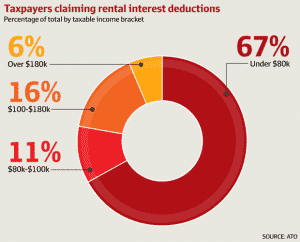
Much has been posited about the typical Australian property investor, especially their salary. According to the ATO, 67% of investors claiming rental interest deductions take home under $80,000 per year.
P 300x242 - MCG Quantity Surveyors

At least as far back as 2014, the data has been pulled apart and commentators have asserted that the data is flawed. Their argument is that the taxable income quoted by the ATO is calculated after deductions, so some of the quoted 67% are actually on incomes higher than that. As it happens, they’re entirely correct. The problem is their assumption that there are copious amounts of negatively geared property barons with super portfolios dragging their million dollar salaries back under $80k. I’m prone to hyperbole, but the way the ATO stats have been blown to smithereens, one would assume this must close to their view in order to dismiss the data outright.
Let’s look at what we know.

• Negative gearing is utilised by about 1.2 million of Australia’s 2 million property investors;
• A total of 91% of those claiming negative gearing deductions had one or two investment properties;
• Less than 1% of property investors own 6 or more properties.

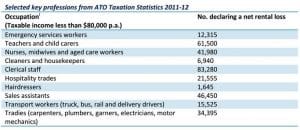
On the basis of the stats showing that most property investors are not sitting on multiple property portfolio’s, it seems a bit ambitious to discount the 67% figure outright. As a consultant dealing with property investors on a daily basis, I can tell you first hand that the overwhelming majority of them are average wage earners. According to the ATO taxation statistics 2011-2012, of those with after-deduction incomes of less than $80k we get the following vocations;
Pp 300x130 - MCG Quantity Surveyors

Source: Property Council of Australia

Of course the Property Council has its agenda, and among the professions utilising negative gearing you’ll see there are plenty of surgeons, lawyers, investment managers and other typically high income wage earners. Should we be surprised? Given that the personal income tax rates ratchet up as your salary increases, there’s a greater incentive to minimise your taxable income. The higher your salary, the greater the benefit you’ll get from reducing your taxable income through depreciation and interest deductions etc. People might say that this proves that the tax system is skewed towards the wealthy but in this instance it only works this way because of the penalty of earning a higher income to start with.

Negative gearing is not a new policy, in fact it’s not far from being a century old. It’s also been abolished before by the Hawk government between 1985 & 1987. What was the net result? Surely that will tell us whether it is a good idea today or not? Well, my view is that it almost doesn’t matter. The difference in the economic landscape of the time makes it only slightly better than a current day economic model. As a policy decision, it certainly hasn’t stood the test of time as an earth shifting structural tax reform that catapulted us towards the new millennium with stuffed pockets.

What is fairly clear is that with 30% of all residential property being rental stock, any changes to negative gearing will likely result in a decrease in property prices. Potentially good news for first home owners, but if they contribute to a super fund with exposure to property or will be the beneficiary of property based inheritance, the good news may come with a sour taste.
Regardless of my bias or vested interest as a property investment advocate, one frustratingly absent consideration from the debate is the fact that self-funded retirees are good news for Australia. With an ageing population, the growing $34 billion dollar spend each year on taxpayer funded pensions is forecasted to increase to $85.4 billion dollars by 2035/2036. That figure even includes the increase in the pension eligibility age to 70 by 2035. Pretty solid expenditure given we’re far less generous to the elderly than we probably should be.

Depending on whom you speak to, negative gearing was introduced originally to either stimulate the construction sector, or encourage private citizens to add to the rental pool. In essence, it appears to do both. Let’s not forget that the governments share of rental stock (housing commission/public housing) has been steadily declining over the least 30 years. Governments cannot afford to fund social housing yet acknowledge social housing as key concern. Creating a disincentive to invest in property is only going to exacerbate the problem of a social housing shortage.
Negative gearing has become the scapegoat for housing affordability, especially since Sydney and Melbourne property appreciation hit double percentage figures. Curiously negative gearing can take credit for that, but not for the flat-line results in the six years preceding the boom. If we want to have a serious discussion about affordability, it needs to start with supply, not negative gearing.

In closing, it’s easy to look at the cost of negative gearing, but it’s a little more difficult to put a price on the advantages. Certainly, any rash change to a policy so embedded into the Australian property market is going to have detrimental effects. For example, if negative gearing changes negatively affected transaction volumes, the revenue from stamp duty would fall. A disincentive to invest in property would affect land tax, pensions, development fees and more. If we’re looking for budget savings, it seems far more prudent to look at the tax evasion techniques of the multi-nationals. With so much of our wealth tied up in property, it’s time to stop using negative gearing as a political tennis ball.

Mike Mortlock is a Quantity Surveyor and Managing Director of MCG Quantity Surveyors. MCG Specialise in Tax Depreciation Schedules and Construction Cost Estimating. You can visit them at www.mcgqs.com.au/

What are Scrapping Schedules?

Authors Note: Scrapping schedules have been impacted by legislation changes and in most cases will not suit your scenario. See more information here – Scrapping Schedules – Why they’re a thing of the past.

The term ‘scrapping schedule’ is thrown about a lot these days, and to be honest, it’s a term that is more confusing than helpful. To begin with, we should look at what scrapping actually is. In simple terms, scrapping is the process of throwing away an asset that has reached the end of its physical life. The benefit from a depreciation perspective is that the remaining written down value of the asset can be claimed at 100%.

There are a few rules which apply, as referenced below, but the question I want to ask is what does a scrapping schedule do that a depreciation schedule doesn’t? In short, nothing! A depreciation schedule provides you with the residual value of an asset as at the time of purchase.
A scrapping schedule will do exactly the same thing, which begs the question ‘Why does it need its own name?”. What’s different is the way in which the schedule is used. A depreciation schedule will provide the residual or opening values of assets, in order for depreciation to be claimed as at the prescribed percentage. A scrapping schedule is used with a view to calculating the residual value as at the time the assets are being thrown away. However, you can do that with both schedules.

We’re getting terribly boring and technical here, but let’s say you’ve bought a property with some carpet and after renting the property for 6 months, you’re wanting to throw the carpet away. If the scrapping schedule shows the carpet was worth $1,500 when you purchased the property, to claim the correct figure when the carpet is thrown away, you need to calculate the decline in value of the carpet whilst it was being used for 6 months. It’s an easy thing for a quantity surveyor or accountant to do, but you must have the opening value as at the settlement date of the property. This is why you NEED a depreciation schedule to claim scrapping. No mater whether you call it a scrapping schedule or a depreciation schedule, both are going to give you the information you need to write-off the asset. A ‘scrapping schedule’ is likely to just be a schedule on the old assets, then the new assets are captured in a ‘depreciation schedule’. The reality is that one schedule can be prepared achieving both things. It’s important that the inspection be completed prior to the removal of the assets, but if the new assets come with shiny receipts (as they most always do), there’s no need for a quantity surveyor to revisit the property, as in most cases there’s no estimating required.

To understand the rules, you can visit our blog here, which includes a detailed analysis of what scrapping and the new assets will mean to your total deductions. https://www.mcgqs.com.au/blog/scrapping-tax-depreciation-writing-off-an-asset/