The bushfires have steadied, the fires that were out of
control are now under control, if not now largely all extinguished. It is now
time for the long road to recovery. Many endless hours of insurance assessing,
demolition of existing destroyed properties, delays due to contaminated waste
(older house with asbestos), thousands of kilometres of fencing to be erected
and then time to rebuild the properties and in some cases the rebuild the stock
numbers and lost fauna.
Yes, it all seems gloomy, but it is progress.
Yes, it will be slow, and frustrations will be vented. Due
in part to the apparent lack of speediness by the various people involved in
this complicated process.
Hold in there.
The world is in damage control with the coronavirus outbreak
(COVID-19) that appears to have it origins and ignition point in Wuhan, China
at Christmas 2019. Now rapidly spreading across the globe to have now impacted
some 80,000 + people.
Why all the doom and gloom, especially from a quantity
surveyor holed up in the comfort of his office.
I mean the content of this article thus far is not exactly
screaming “positivity or would be used at an inspiration seminar”.
Perspective people, perspective.
I wanted to make you aware of a word……. Embargo.
Noun
an
official ban on trade or other commercial activity with a particular country.
“an embargo
on grain sales”
verb
impose
an official ban on (trade or a country or commodity).
“all
of these countries have been embargoed by the US”
Sure, I would think you have heard about this term before.
Within the example used in the Noun above, it is not just applied or used on
grain sales.
To revert back to the opening line of this article, “The
bushfires have steadied……”.
Did you know that many of these areas that were engulfed by
fire and destruction had been, well, there was an embargo in place on property
insurance in those areas?
That’s right, it is a very common practice that insurance
companies and insurance underwriters will place an embargo on a particular
postcode or geographical area if they believe they are exposed to massive loss.
This is not to say that if you already have insurance in
place that it is void, however it does mean that should you not have insurance,
or you have let it expire, they very well may not allow a new policy to be put
in place on your property. In some cases, you are not even allowed to amend
your already current insurance policy.
As an example, if you have an existing policy and you have
just erected a new metal shed / garage in the backyard, you should consider increasing
your policy or add it to your policy. If the area was embargoed, you may very
well be under insurance as it may not be included for a period of time.
What is the reason for today’s article?
As Benjamin Franklin famously once said,
“Don’t put off until tomorrow what you can do today”.
It may well be too late if a storm is on the way or a fire
is ranging toward the back fence or water lapping at the street frontage.
An embargo restriction applied by an insurance underwriter
may be placed on a geographical area simply based on the fact that the
insurance underwriter believes that an area, or areas, is extremely likely to
be impacted. Not always that it IS ACTUALLY being impacted, but likely
to be.
I guess an example here would be a cyclone warning and a
projected path.
The embargo or restriction on an area usually comes with a
timeframe, which would seem logical, for example 72 hours or 7 days.
From the insurance underwriter perspective, in the past,
they have been exposed to scenarios where a client does not have any insurance
in play, however when a warning of an event or as an example a cyclone or
bushfire is on its way, take out an insurance policy.
After the threat has past, make additional contact with the
insurance underwriter and cancel the policy.
Embargoes on insurance are a normal and accepted practice,
and usually apply to new policies. They typically take effect when events such
as fires, floods and cyclones threaten to impact a certain area (or already
are). However, these embargoes can be across all forms of insurance as home,
contents, motor, business and travel.
If an insurable risk is imminent, the probability of that
risk occurring and therefore a claim being lodged is consequentially elevated.
Insurers, operating prudentially, would need to calculate a premium that
reflects this elevated risk, rather than averaging the risk over an entire
year. This would typically make a risk based premium unaffordable to a homeowner.
Not all insurers impose embargoes.
Australia’s insurance market is large and highly
competitive, and at any one time there are usually insurers who have not
enacted an embargo.
How to avoid being caught out by an embargo?
Make sure you have insurance in place all the time. Ensure
that your cover has been taken out well in advance of disaster season for your
location and avoid allowing it to lapse. Summer is a big part of the disaster
season here in Australia, generally speaking. We have most of our rainfall and
bushfires in the summer months.
However, think about your location, for example the tropical
North of Australia will have periods of high chance of increased rainfall (wet
season) and cyclones (storm season). Toward the alpine areas of Australia,
winter is also going to be a period concern with high snowfall.
Anyone in Melbourne should be on high alert ALL YEAR.
On any given day it could be raining, sunny, windy, snowing, cyclonic, raining
again, windy and cold.
As an example of what you can do to be more aware of these
weather activities and potential embargoes, I was doing some research and came
across a great website.
Early Warning Network Website
http://www.ewn.com.au/
Some of the services that they note on the website include:
- Location Based Warning Systems
- Local weather outlook
- Situation room
- National significant weather threat map
- Commercial location alerts
- Regional alerts
- Insurance embargoes
- API
- Flood monitoring and Warning
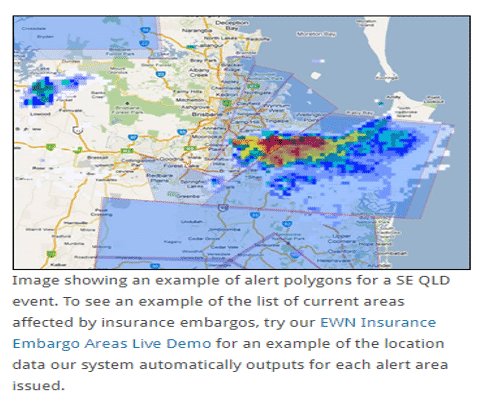
On the Early Warning Network website, it shows the areas
where embargos are in place. As an example, it would look something like this.
In addition to this, I would suggest that using the ICA
website is a good practice.
The Insurance Council of Australia has some great content on
the website and will help you regarding finding an insurance underwriter that
is willing to provide you cover even in an embargo.
In addition to this, they also provide data on the health
and trends in the insurance market.
A snapshot of the Domestic Insurance Trends from 2002
Quarter 1 to 2019 Quarter 3, Is shown below:
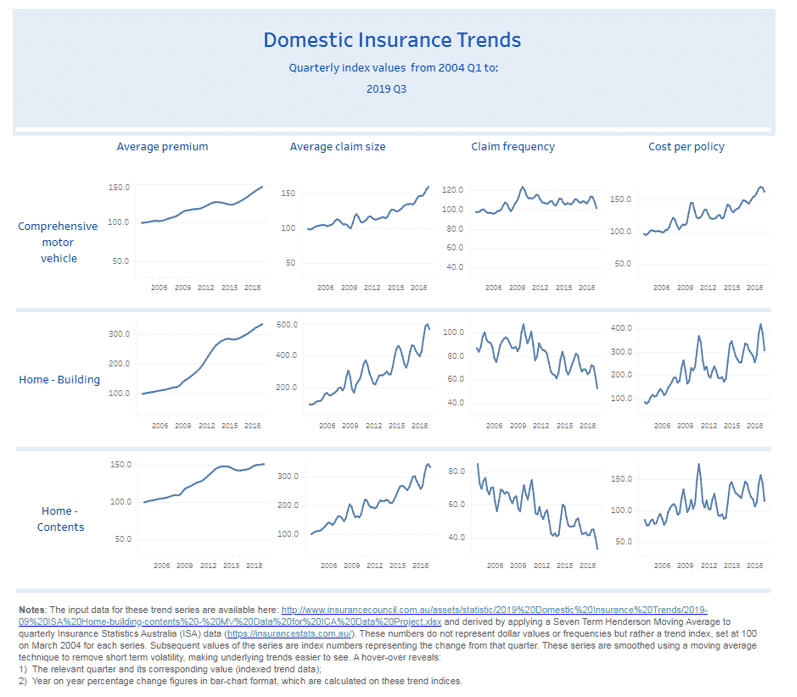
You can see the average claim size for ‘Home – Building’ has
been steadily increasing from well below the $200,000 mark in 2004 to now well
over the $600,000 mark in 2019.
Either our homes are getting more expensive to build, or
more of the house is being impacted in the event, moving more toward total loss
rather than partial damage.
The next graph along from that is the claim frequency, which
will after the most recent events of bushfires and floods be taking a hike northward.
Since the 8th November 2019 through to now, a
reported by the Insurance Council of Australia, some 13,750 bushfire insurance
claims have been lodged, totalling damages of $1.34 billion.
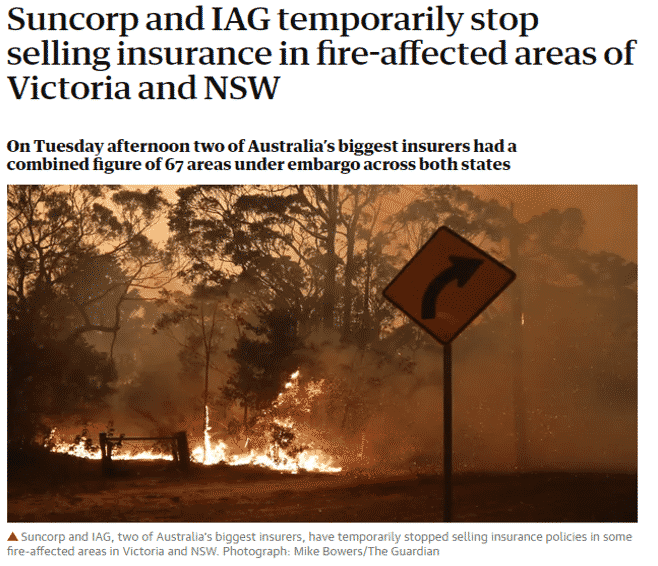
An article in the Guardian Newspaper as of around the 14th
January 2019 this year, noted that both Suncorp and IAG, two of Australia’s
biggest insurers had a combined 67 embargoed areas on their books.
I know I have been on my soapbox regarding underinsurance and inaccurate use of website calculators over the years, however, it seems that the industry just did not have a voice. It appears since my rants have become more public; the supporting voices are now coming out of the woodwork.
Like Jonathan Brown of the consumer group Choice.
“Like all insurance decisions, that’s entirely up to you.
You need to carefully consider your own circumstances and look at independent
advice beyond calculators provided by insurers and commercial brokers or
websites”, says Jonathan Brown.
And now, even Campbell Fuller of the Insurance Council of Australia
(ICA) has publicly announced on the ABC that:
“About 80% of insured property owners are probably under
insured”, says Campbell Fuller of the ICA.
That was a direct quote from my last article on the inaccuracies of the online calculators within the industry. So, thank you, Mr Fuller.
For the residential property owner or homeowner, there is really
two types of insurance that you can take out on your property.
- Total Replacement Cover, and
- Sum insured cover.
The sum insured value will cover you up to the set amount
you choose to repair or rebuild your home.
So, in this circumstance, in my opinion, YOU MUST use the
services of a quantity surveyor to determine what the rebuild cost will be.
However, Jonathan Brown of the consumer group Choice,
further notes recently that:
“Some of the worst clauses allow insurers to base payouts
on the rates they can purchase materials and labour at, rather than the actual
cost of rebuilding or repairing your home”
“It may be worth considering a total replacement policy”
Mr Brown says.
As I have said before, know your numbers. The fine print on
policies do mean something and are worth your time.
Without being absolutely risk adverse on everything in life,
I believe that from time to time, it is worth taking into account the worst
that can happen in any particular scenario, then move backwards eliminating the
risk or putting things in play to reduce the risk.
Let’s keep positive people, outstretch that arm and hand of your and help someone that could do with the help. It is not just property, lives and animals that were lost in the brutal bushfires recently. Communities have been as well. Let’s all do what we can. Travel to these affected areas, if nothing else, spend our money locally to them to help to rebuild these communities.