If
we compare the number of homes that commenced construction in 2018, compared to
2019, 2018 wins. In fact, the total number of homes that commenced construction
in 2019 was 174,246.
The
total number of new homes that commenced construction in 2019 was 22.6 percent
lower than in 2018.
So,
over the full year, 2019 was not as great as the previous year. However, as an
industry, we had a lot to deal with.
Within
the property sector, there does seem to be headwinds in some way, shape, or
form each year. 2019 had it’s fair share though. We had the Financial Services
Royal Commission handed down its findings, the Australian Prudential Regulation
Authority (APRA) started the year with a firm hold on the industry, Federal and
state elections were held.
Earlier
in 2019, Geordan Murray, the HIA Senior economist had said, tax changes on
property ownership, such as the opposition Labor Party is promoting ahead of
the May 18 federal election, would only make the situation worse.
“State
and federal governments should be looking at ways to sure up confidence in the
housing market, for both owner-occupiers and investors,” HIA senior
economist Geordan Murray said.
Then,
on the 21st May 2019, APRA, the banking regulator, proposed
relaxation of lending restrictions.
Coupled
with the Reserve Bankrolling out two consecutive interest rate cuts. Surely
this would start to see the 2019 year improve. Surely this was the road back to
recovery.
Martin
Farrer, of The Guardian, published on the 16th November 2019, What
has caused the turnaround?
In
his opinion, CREDIT.
“The
simple answer is credit. Just as the downturn was caused by Apra’s 2017
decision to restrict credit amid alarm about
poor lending standards, the upturn has coincided with a loosening of credit
restrictions”.
The
founder of SQM, Louis Christopher, says Apra’s post-election U-turn was
crucial.
“With
Apra, what they really did was, someone, knocked on their door and said, ‘Look,
you’ve gone too far, we’ve got a downturn in the economy, you’ve got to loosen
the lending restrictions.’ And they did.”
The
second half of 2019 showed a marked improvement in housing market sentiment with
suggestions that demand for new homes would return to growth going into 2020.
This
month, on the 15th April 2020, The ABS released building activity
data for the December quarter of 2019, rounding out the full calendar year
results.
Maybe
we are back on track. In December 2019, leading indicators of building activity
that showed an improvement in new home construction, there was a 1.2 percent
increase in new home construction in the December quarter.
“There was a small increase in the number of
new homes that commenced construction in the December quarter,” said Angela Lillicrap,
HIA Economist.
“This
quarterly increase at the end of 2019 was reported in both detached dwellings
and multi-units, increasing by 0.1 percent and 2.9 percent respectively.
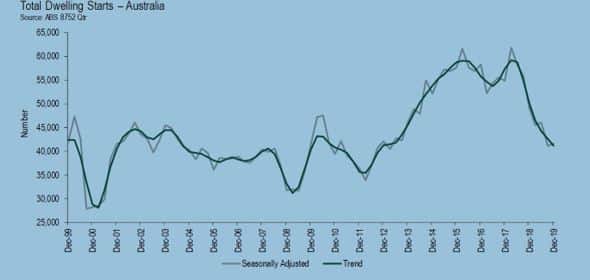
With December 2019 showing the number of new homes starting
construction being just above the 40,000, we had not seen these low numbers
since December 2013. With December 2017 being between the 55,000 and 60,000
mark numbers.
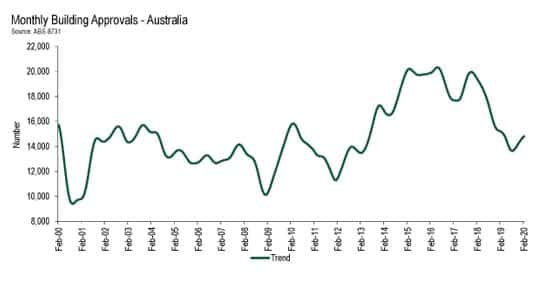
As we moved into the new year, a decade even, building
approvals were on the rise.
“Building
approvals increased by 3.9 percent in the three months to February 2020
compared to the previous three months, providing further evidence that the
housing market was accelerating into 2020,” stated HIA Economist, Angela
Lillicrap.
“Approvals
strengthened across the board with both detached houses and multi-units
experiencing quarterly increases of 2.9 percent and 5.4 percent respectively.
From
this, we know that up until at least the end of February, home building
activity across most regions for 2020 was looking at the improvement.
In
seasonally adjusted terms, building approvals for the three months to February
2020 quarter showed:
Victoria
(+22.6 per cent),
Western
Australia (+1.1 per cent),
Tasmania
(-7.3 per cent),
New
South Wales, (-5.2 per cent),
Queensland
(-4.9 per cent),
South
Australia (-17.4 per cent),
Australian
Capital Territory(+ 1.0 per cent), and
Northern
Territory (- 6.7 per cent.).
From
this, what I see is that we have a property market on the improvement. Then we welcome
COVID-19 to our shores. Although we lock the door and do not want it to enter,
it comes in anyway.
With
various stimulus packages being rolled out, Government incentives to encourage
support and continued employment, it is fair to say that the construction
industry is still open for business.
The
Australian Government was pledged $1.3 billion to support keeping apprentices
employed, by way of a $21,000 per apprentice subsidized wage.
A
month ago, HIA Managing Director, Graham Wolfe, said,
“The
measures that the Government has announced will help many small businesses
continue to operate in this uncertain environment.”
“As
an industry that employs over 1 million people and injects billions into the
economy, the residential building industry can play a key role in keeping the
economy ticking over and lead the economic recovery that will happen once the
virus passes,” concluded Mr. Wolfe
As
I had noted earlier, one of the key drivers for the change from early to mid-2019
has been credit, or the ability to gain credit.
We
now have more headwinds. 2020 is no different. It is not a royal commission, or
a federal election, but a worldwide pandemic.
However,
if the industry has access to credit and can continue to build, then we have a
chance.
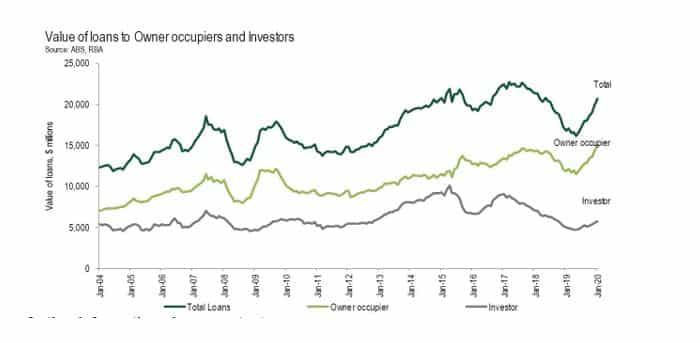
The
value of lending to owner-occupiers (construction of new homes) in January 2020
has increased to 13.2 percent higher than back in April 2019.
Written by Marty Sadlier
Founding Director and Owner at MCG Quantity Surveyors