Depreciation and the Instant Asset Write-off – Economic Stimulus Package 2020

Here’s what you need to know about the changes to depreciation allowances and the instant asset write-off changes as part of the Governments $17.6 billion coronavirus economic stimul…

Here’s what you need to know about the changes to depreciation allowances and the instant asset write-off changes as part of the Governments $17.6 billion coronavirus economic stimul…

Here’s what you need to know about the changes to depreciation allowances and the instant asset write-off changes as part of the Governments $17.6 billion coronavirus economic stimul…

Percentage of property investors with an ‘in-depth audit’ from the ATO

On the 30th April 2020 the release of the final report of the Public Accountability Committee, titled ‘Regulation of building standards, building quality, and building disputes’ was tabled with…

On the 30th April 2020 the release of the final report of the Public Accountability Committee, titled ‘Regulation of building standards, building quality, and building disputes’ was tabled with…

On the 30th April 2020 the release of the final report of the Public Accountability Committee, titled ‘Regulation of building standards, building quality, and building disputes’ was tabled with…

Review of the Ripehouse Advisory COVID-19 vs Australian Property Report

I recently took part in the Ripehouse COVID-19 survey along with 146 other industry experts and academics and have now been able to view the report in full. I commend the team for…

I recently took part in the Ripehouse COVID-19 survey along with 146 other industry experts and academics and have now been able to view the report in full. I commend the team for…

I recently took part in the Ripehouse COVID-19 survey along with 146 other industry experts and academics and have now been able to view the report in full. I commend the team for…

Regulation of Building Standards – Final NSW Government Report

On the 30th April 2020 the release of the final report of the Public Accountability Committee, titled ‘Regulation of building standards, building quality, and building disputes’ was tabled with…

On the 30th April 2020 the release of the final report of the Public Accountability Committee, titled ‘Regulation of building standards, building quality, and building disputes’ was tabled with…

On the 30th April 2020 the release of the final report of the Public Accountability Committee, titled ‘Regulation of building standards, building quality, and building disputes’ was tabled with…

Coronavirus create most competitive building environment since the GFC

A study by MCG Quantity Surveyors has revealed property owners are now securing the most competitive building and renovation environment in almost a decade. MCG Quantity Surveyors…

A study by MCG Quantity Surveyors has revealed property owners are now securing the most competitive building and renovation environment in almost a decade. MCG Quantity Surveyors…

A study by MCG Quantity Surveyors has revealed property owners are now securing the most competitive building and renovation environment in almost a decade. MCG Quantity Surveyors…

How I’d Repair The Government’s Homebuilder Policy

I’ve been buoyed by the political bipartisanship that’s, so far, seen us deal successfully with the health risks and financial pitfalls from the coronavirus crisis. Up until recently, there’s been a joint effort from both sides of the fence to find workable solutions.

I say ‘up until recently’ because one policy just put a handbrake on all this brotherly love.

The Homebuilder schemes.

This one piece of policy has begun pulling at the seams of unity.

And while there’s been plenty said in criticism of the plan among commentators, I’ve yet to hear from an industry professional willing to put forward their ideas for improvement.

Sounds like a cue for me to enter the fray with my two-cents worth.

I think while Homebuilder has its flaws, it’s also entirely saveable, and here’s how I’d do it.

The scheme

In summary, Homebuilder allows for a grant of $25,000.

It applies when a new home is built and the property value does not exceed $750,000, or an existing home valued at less than $1.5 million is renovated and the cost of works is between $150,000 and $750,000.

The scheme only applies to a principal place of residence, NOT an investment property.

It’s means tested as well. Grant applicants must be a ‘natural person’ (i.e. not a company or trust) with an annual gross income under $125,000 for individuals, or $200,000 for couples.

It’s time sensitive too, so the construction contract must be signed between 4 June 2020 and 31 December 2020, and the work must commence within three months of the contract date.

The faults in our Homebuilder

Now, in principle, the concept behind Homebuilder is sound.

Not only does Mr and Mrs Public get a new home or a nice little upgrade to their existing property, but we boost employment and commerce in one of Australia’s largest industries creating flow-on improvements to the economy overall.

But look a little closer at the policy, and cracks begin to appear.

I think in a rush to create Homebuilder, our Federal Government failed to consult widely enough with industry experts before launching the plan. As a result, it’s unlikely to do what was hoped.

In short, it’s well intentioned, but poorly executed.

For starters, if you can find a home that can be built in Australia’s biggest real estate market – Sydney – for under $750,000, then a big congratulations. Every major builder I spoke to say this unicorn does not exist.

In addition, MCG’s 1000 Assets study revealed the national average renovation spend is around $30,500 – well short of the $150,000 minimum. Plus, any professional renovator will tell you it’s madness to have a renovation budget greater than 10 per cent of your property’s post-renovation value. So, by the scheme’s logic, you’re spending a $150,000 to raise a property to $1.5 million, which simply doesn’t stack up.

Also, under the criteria, most people who qualify for Home Builder under the means test will not have the financial wherewithal to complete builds. If they do have that sort of dough on hand, they’re probably outside the income threshold and won’t qualify.

Think about it. If you went to a financial planner and said, “I’m going to spend $150,000 on a renovation but my wife and I only gross $200,000 a year. Do you think that would be a good idea during this recession?” they’d be justified in laughing in your face.

If the ATO want to get the inside running on who to audit next year, I’d say they should be looking at anyone who qualifies for this grant, because they obviously have an additional income stream they’re not declaring.

Also, applying for a construction loan is a tough ask at present, and it takes a long time to get approved (or rejected). Add to that the process of design, planning approvals, contractor sourcing and commissioning a builder, and suddenly that six-month window for the scheme is pretty well closed.

How to fix Homebuilder

Firstly – separate it into Homebuilder and Home Renovation. They are different client and builder types and involve different processes and challenges. The current plan also locks out specialist contractors like bathroom subbies because Home Builder requires a registered builder to manage the whole process.

Secondly, open up the criteria. Who cares if those on higher incomes get access to the grant? The idea is to boost spending in construction, not sweat about whether financially secure folk qualify.

Thirdly apply a sliding scale or percentage of the build cost to the grant and cap the maximum pay-out at $25,000. That way smaller renovations will qualify for smaller amounts, but no one will receive more than the maximum figure.

Next, limit the total pool of money on offer and release it on a ‘first come, first served’ basis. The government could, say, allow $600 million for the program initially and then turn off the tap when that’s exhausted. If successful, the second tranche of funds could be made available at a later date.

Finally, open-end the date of the offering until the funding pool runs out. This allows plenty of time for appropriate planning, design, finance approval and builder selection by clients.

By making a few simple tweaks, Homebuilder could be a brilliant plan to help boost the construction industry, but its current form just doesn’t cut the mustard.

For any politicians out there looking for some professional guidance, give me a call.

Written by Marty Sadlier
Founding Director and Owner at MCG Quantity Surveyors

Renovation Cash Grants – Please, Prime Minister, I want some more

I went out for dinner last night. This would not normally be a news story, but in the current landscape, I could write an article just about that!!!!!

Fresh in the back of my mind was the article that I recently wrote for the Australian Financial Review, about the Federal Government’s announcement on Monday of the housing stimulus package.

For those of you that missed it, Prime Minister Scott Morrison confirmed the government was considering giving householders cash grants for home renovations.

I started to think about “What if this actually gets approved?”

I then started to think about my own Principal Place of Residence (PPOR) and my investment properties (IP). Would the grant be extended to investment properties as well? or just PPOR’s.

Then the cogs started to turn:

  1. What would I do to my own house?
  2. What would I do to my investment properties?

As I glanced back to the menu to order my dinner, it hit me………

……. What is everyone else going to do?

What if they had a menu to scroll through to see what they would be able to do to their own properties?

I raced home and did this up for you.

Pm1 - MCG Quantity Surveyors

Imagine if you could order an ensuite, laundry and internal painting please. “That will be $49,038 please sir.”

But wait, what about the tax depreciation deductions I would get on the Investment Properties?

Of that $49,038 I would get a tax deduction of $8,319.50 in the first 5 years.

Pm2 - MCG Quantity Surveyors

Order away my friends, the service is quick and the returns…….amazing.

Written by Marty Sadlier
Founding Director and Owner at MCG Quantity Surveyors

Review of the Ripehouse Advisory COVID-19 vs Australian Property Report

I recently took part in the Ripehouse COVID-19 survey along with 146 other industry experts and academics and have now been able to view the report in full. I commend the team for putting the report together, especially during such a fluid and evolving set of circumstances. Real estate is such a pivotal part of the Australian fabric and the report cuts through much of the typical media noise around the very real concerns homeowners and investors have alike for the trajectory of the property market.

The research asked several questions of the experts around the likely direction of property prices based on a framework which is very likely to almost exactly match the real word scenario. Thankfully that makes the opinions and information even more valuable.

The report was broken into a number of key areas and I’ve addressed five of them individually below;

  1. When will property be hit hardest?

The consensus view was that it would likely be at least three must before we saw the evidence of any price movements within the data. Realistically, my view is that this the minimum time frame due to the lagging indicators and time it takes for a property to be properly marketed by the agents and for a settlement to take place and be report by the ABS, Core Logic etc. It remains to be seen if there will be some properties hitting the market with a shortage of buyers as suggested by REIWA President Damian Collins. I certainly think that opportunistic buyers will be active in the market and it’s a possibility that we’ll see extremely low transaction volumes but potentially a relatively balanced supply and demand equation. However, it’s likely that the buyers will be in the strongest negotiation position and certain locations and sectors of the market will suffer far more than others.

  • Which housing demographic is most exposed to COVID-19 Fallout?

The report found that 42% of respondents believed that lower socio-economic areas would be most impacted. In my opinion the definition of ‘exposed’ is interchangeable with ‘suffer(ing) hardship’. Those mostly likely to suffer hardship are property owners without a significant enough buffer to weather the storm. Active property investors in their accumulation phase are typically highly leveraged and this could force them into a position where they need to sell if their tenant isn’t able to pay rent. Of course, the freeze on mortgages from the banks provides some significant respite to those in that situation. The same issue of having a buffer is true for households. There’s enough evidence to show that even average households don’t sit on cash reserves that would enable them to go without employment for a month or more, with those in lower socio-economic demographics living much more week to week. Those employed in casual positions, and or in industries such as travel, hospitality and retail are likely to suffer disproportionately in my view.

  • Which state do you think will be hit hardest?

Around 73% of experts pointed toward NSW as the state most likely to be hardest hit. NSW has suffered the highest infection numbers and when combining this with a higher density than other states and a higher cost of housing, this makes NSW more venerable to cost of living pressures as unemployment increases.

  • Which property sector will be most impacted?

The report highlights that most of the identified sectors are likely to suffer, with retail, hotel, holiday homes and AirBnB style properties taking the brunt. Respondents were clearly most concerned by AirBnB properties in their comments. I’m included to agree with Damian in that those with flexibility to move back to a tradition rental model will minimise their losses and that holiday homes will suffer for the next little while, especially in regional areas with high unemployment.

  • Do you see upwards or downwards pressure on price?

This question was an interesting one that presented some interesting answers. The question asked about prices looking towards March 2021, so roughly 12 months’ time. Many commentators suggested prices would be the same, if not higher. My view is that it’s just a question of timing. There’s no doubt that the strong fundamentals pre pandemic will return, but it’s a question of whether 12 months is enough time. My view is that it’s possible, but 12 months is probably the earliest we could see prices rise unless we see a relaxation of lockdown and distancing measures before the end of middle to end of May.

The report shares some adroit suggestions on the suburbs most likely to be hardest hit and is well worth a read. No surprises that locations with a high exposure to short term accommodation and tourism are predicted to be hardest hit.

In summary, the report provides some excellent insights from industry experts and commentators, as well as policy suggestions to help the property sector remain robust, which is especially important given how import it is to State Government budgets and as a major employer of Australians.

As for how the crisis likely to impact the Quantity Surveying/Tax depreciation sector, it will be like many other industries that are reliant on transaction volumes such as real estate agents, conveyancers, pest and building companies etc. However, the data shows there’s a significant lag effect between the actual transaction and an investor contacting a quantity surveyor. This indicates that most of the ‘pain’ will likely arrive at least 3 months after the market starts to move. Unfortunately, that exposes companies with pipelines that lag the market as much of the support nets such as Job Keeper arrangements are set to expire in September. Hopefully the curve continues to flatten, and our rates of infection continue to decline, and we don’t suffer localised outbreaks as we begin to relax the lockdown measures. The best news for the real estate sector is a swift and safe return to normality as soon as possible.

Mike is interviewing Ripehouse Advisory CEO Jacob Field on a live webinar on Wednesday the 6th of May at 7.30pm. Register here for the event or a copy of the replay and we’ll get you a copy of the research paper.
https://event.webinarjam.com/register/7/yyvrgsv

Mike Mortlock is a Quantity Surveyor and Managing Director of MCG Quantity Surveyors. MCG Specialise in Tax Depreciation Schedules and Construction Cost Estimating. You can visit them at www.mcgqs.com.au Mike Mortlock is a Tax Depreciation expert, Quantity Surveyor and Managing Director of MCG Quantity Surveyors. He is a regular speaker and commentator having been featured in the Financial Review and Sky Business. MCG Specialise in Tax Depreciation Schedules and Construction Cost Estimating for investors. You can visit them at https://www.mcgqs.com.au

Coronavirus creates the most competitive building environment since the GFC

A study by MCG Quantity Surveyors has revealed property owners are now securing the most competitive building and renovation environment in almost a decade.

MCG Quantity Surveyors were recently featured in the Australian Financial Review on the back of their recent analysis of construction contracts prompted a survey of builders which revealed most are dramatically reducing quotes to secure work.

We believe the coronavirus crisis has opened a window of opportunity for property owners to make substantial savings on building costs, but it has the potential to close just as quickly, so you must stay on your toes.

The last time that we really were witness to such a dramatic correction in the market was during and after the global financial crisis (GFC). It was after the GFC a committee was formed to examine the impact of change on regional Australia and test policy responses.

The current environment bore similarities to what we saw during the GFC apart from one major difference. During the GFC it was difficult to determine how long it would take for confidence to return and the fallout ran for many years afterward.

With the current crisis, it’s more likely that the relaxation of restrictions and perhaps a medical solution will boost confidence quickly.

At the request of the Parliament of the Commonwealth of Australia, titled “the Global Financial Crisis and regional Australia”, formed the Standing Committee on Infrastructure, Transport, Regional Development & Local Government. The findings recommendations and responses were released in November 2009.

The Chair, Ms. Catherine King MP, noted within the forward, “The GFC should be seen as an opportunity to. The lessons learned will assist in strengthening existing regional development policy, which will help regional Australia withstand future downturns.”

The Committee reported on the evidence it received, noting the effects of the crisis, the key sectors reviewed were:

  • Resources;
  • Manufacturing;
  • Tourism;
  • Retail;
  • Construction;
  • Primary industries; and
  • Banking and lending.

From a quantity surveying perspective, focus pertaining to the construction sector has been of most interest, with an attempt to compare the GFC to that of the potential fall out of the COVID-19 pandemic currently tearing its way across the globe. Have we learned anything from the GFC that can be applied by way of focusing our vision?

The committee’s findings from the review of the GFC found that perhaps more than any other sector of the economy, the construction industry can be ‘notably affected by the economic cycle’, in particular the economic conditions created by the GFC.

It was concluded by the committee that the lack of available credit at the time impacted heavily geared sectors such as commercial and medium-density property construction, coupled by the declining output from the nation’s mines, factories, office blocks, and shopping centers means that the ‘incentive to construct additional capacity is weak’.

Does this not at the very least present a similar landscape to the one we find ourselves in currently?

Okay, a global pandemic is not the same as “the residential housing bubble, Bursting”, but are we not going to have to claw our way back out of the doldrums after the COVID-19 annihilations of the Australian construction sectors. Are they not going to be similar in terms of the long road to recovery?

As a point of reference, let’s refer to the ‘Producer Price Index’.  The PPI is a “price index that measures the average changes in prices received by domestic producers for their output. Its importance is being undermined by the steady decline in manufactured goods as a share of spending”.

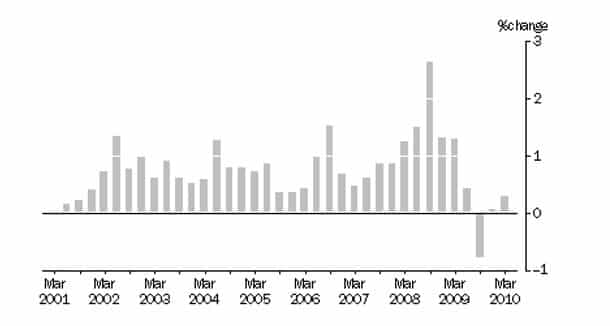
What can we learn from the PPI of the materials used in house building at the end of the March Quarter in 2010?

The Australia Bureau of Statistics (ABS) indicates that the price index of materials used in house building increased by 0.3% in the March quarter 2010.

This followed a 0.1% increase at the end of the December quarter 2009.

A decrease of 0.8% in the September quarter 2009

MATERIALS USED IN HOUSE BUILDING, All groups: Quarterly % change
AFR 1 - MCG Quantity Surveyors

The graph shoes the crescendo of price increases in the midst of the GFC, the decline toward the end of the GFC with the negative result at the end of the September quarter 2009.

It is this PPI analysis post-GFC that should be of interest to the Australian Construction Sector in 2020-2021. Post COVID-19, construction will once again recommence across the country without isolation and the shackles of the pandemic.

We are working with builders now where we simply can’t get to their costs under the usual analysis. For example, we have a builder who we are constructing a residential unit development for $2.5 million, and our QS assessment, based on their usual rates for the same type of development 8 months ago was $2.8 million.

It’s fair to say that if you had a building contract priced and quoted 12-months ago and then had that same contract priced today, the 2020 amount to build would be much less.

MCG Quantity Surveyors surveyed builders with whom we’ve had a business relationship and the results show owners ready to seek a quote from a builder have been handed a golden opportunity to get maximum construction bang for their buck.

There will be an approach to ‘make up for lost time’, a capacity to achieve a full roster of labor and programs of work.

Instead of waiting the many months to secure a tradesman, whilst only being able to even contemplate selecting from a select few, there will be a plethora of sub-contractors for all trades.

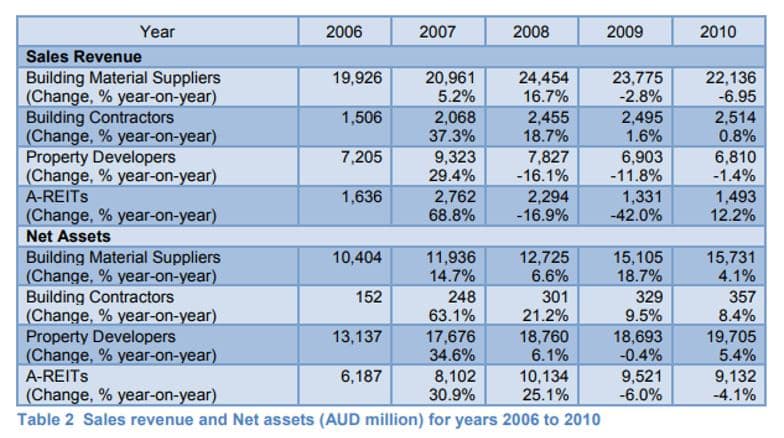
Post GFC, Ram Karthikeyan Thangaraj, and Toong Khuan Chan (The University of Melbourne, Australia) published a paper titled “The Effects of the Global Financial Crisis on the Australian Building Construction Supply Chain”.

This study involved a financial analysis of 43 publicly listed and large private companies in the building and construction supply chain from 2006 to 2010.
AFR 2 - MCG Quantity Surveyors

Interestingly enough, albeit the stimulus packages implemented to support builders and material suppliers were rolled out, toward the end of the GFC and into 2010, Sales revenue and net assets for both materials suppliers and building contractors started to fall.

Whereas, the Real estate had started to improve in terms of sales revenue.

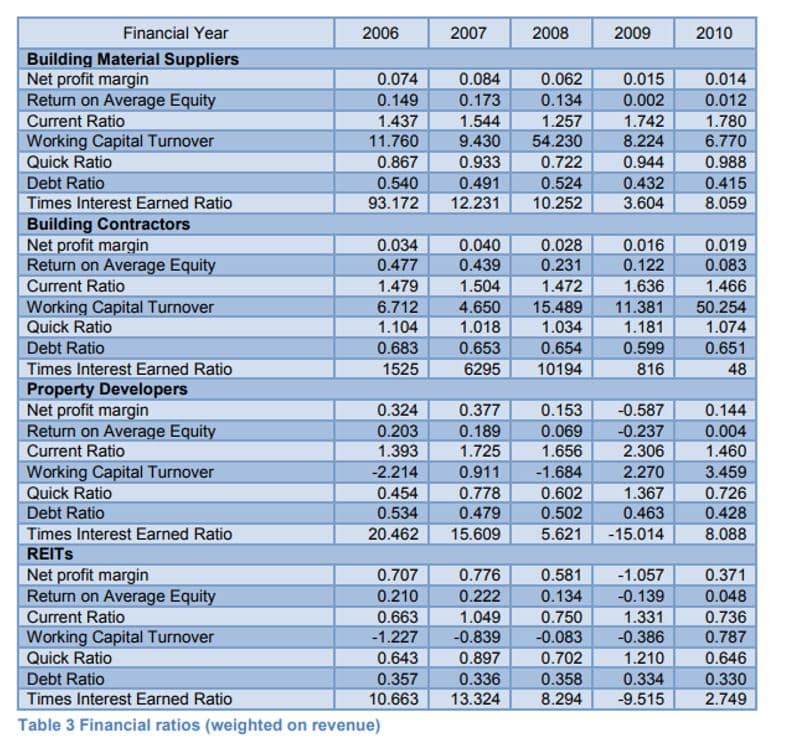
When comparing the net profit margins of these same 4 sectors, building material suppliers were the only sector to decrease in net profit margin year on year.

In terms of profitability, the net profit margin (net profit divided by sales revenue) for material suppliers reduced progressively from more than 7% in 2006 to 1.4% in 2010.

The net profit margin for building contractors was low at between 3.4% in 2006 and reduced to a minimum of 1.6% in 2009. It recovered slightly to 1.9% in 2010.

The net profit margin for property developers was more than 32% before the onset of the GFC, then fell through the floor to reach -59% loss in 2009.
AFR 3 - MCG Quantity Surveyors

Covid-19 is having an impact on the construction sector, inevitably for some further time to come. The landscape will be vastly different from what we have seen over the years 2014 to 2017.

When taking this conversation directly to a developer in April 2020, Melbourne based developer Mr. Tom Howgate of Kincrest, indicated that the headwinds are not funding availability, however councils increasing open space contributions and the whole environment becoming hyper-competitive, very quickly.

MCG Quantity Surveyors sent a series of questions to nine builders with experience in projects from large scale commercial and residential ventures through to new-home builds and renovations.

The summary of the opinions was unanimously centered around the decline in construction costs and was attributable to four (4) elements:

  1. Workflow’s rapidly declined

Around half of the builders have seen their work pipeline halt.

While some have projects locked in for the rest of 2020, just under half the builders had projects nearing completion and they’re struggling to secure new work. Some have also had to halt work due to social isolation rules. Some builders have clients under financial stress who have needed to shelve their project with hopes of picking up again once the crisis has passed.

This was also evident with builders looking after mum-and-dad home projects, they also had found their work drying up.

When owners are out of work, finance becomes a major headache and some have put a stop to builds that are already underway. This has seen a rising number of builders finding themselves back on the market.

  • Margins being cut

We found that builders are now willing to sacrifice their profit margins in order to keep their business operating.

In the current environment, builders are looking to simply keep going in anticipation of better days, and many are willing to ‘work for free’ in order to keep the doors open.

This was made most apparent given seven of the nine I surveyed confirmed they were planning to, or had already, cut their margins in order to win work. Despite this, some were already losing work to others quoting at below cost price.

  • Subcontractor rates plummet

Subcontractors were slashing their hourly rates so as to keep jobs.

All nine builders said their subcontractors are becoming hyper-competitive. The builders expressed that they had never seen an environment like this where highly-skilled and sought after tradesmen were hungry for work.

“It’s no longer ‘can I find a tiler” because they’re all booked out. Now you’re going to have your pick of every tiler in the country”, said one builder.

“Subbies who are already on the builder’s books are cutting their rates to stay in with their head contractors, while new subbies are increasingly making contact looking for work”, said another.

This has been exacerbated by the shutdown of major projects where subcontractors thought they were locked in with employment for the next year or two. Many of these jobs have been shuttered and there’s now a flood of subbies looking for employment.

This means that head contractors are able to secure subcontractors at extremely competitive rates, and those saving are being passed on to customers through lower quotes in an attempt to win work.

  • Cheaper materials

Builders also expressed that certain building materials have become more affordable to the source.

The general consensus is that for staples such as floor coverings or brickwork, suppliers are now more competitive, but specialist items such as light fittings or imported finishes were less likely to see price drops.

Furthermore, there is no delay in sub-contractors getting quotes back into their builder clients. Where a subcontractor would need to be chased for a price and hounded, we are seeing quotes coming in hours or only a day or two.

Of course, timing is everything. The crystal ball moment is hard to define. Once those builders have filled their books with projects, you won’t get a builder to do your job.

Written by Marty Sadlier
Founding Director and Owner at MCG Quantity Surveyors

Final NSW Government Report into Building Standards and Quality

On the 30th April 2020 the release of the final report of the Public Accountability Committee, titled ‘Regulation of building standards, building quality, and building disputes’ was tabled with the Clerk of the Parliaments of NSW.

The report and its recommendations are now with the government for consideration. The government is required to respond to the recommendations within six months.

I am proud to have been involved as one of the contributors to this review and that my opinions were included with the final report to the government.

This report highlights the systemic issues plaguing the building and construction industry and the lack of regulation and oversight by the NSW Government. Alongside the deeply concerning issues regarding flammable cladding, private certification, and the role of strata committees in dealing with defective buildings.

The issue of flammable cladding is a major public safety issue. It is widespread and requires urgent attention.

The committee chair, Mr. David Shoebridge noted within his forward to the final report “The response from the NSW Government in addressing the issue of flammable cladding so far is wholly inadequate”.

Lack of direction and leadership surrounding the issues surrounding flammable cladding has had a massive impact on the cost of insuring buildings containing flammable cladding. It is imperative that the NSW Government acts to address the insurance failure, not only in relation to cladding but insurance across the entire building and construction industry.

This report also focuses on the concerns surrounding private certification.

“It is clear that the experiment of the last 20 years with private certification has not worked”, noted Mr. Shoebridge.

Whilst it is clear that the status quo is broken, and that public control of certification needs to be strengthened, however not by reverting back to local councils.

Instead the finding with the final report recommends a further inquiry be planned to review the NSW Government’s reforms into the building and construction industry.

The final issue the committee considered is the role of strata committees in dealing with defective buildings. Given defects are a common issue, particularly in apartment buildings, it is essential that strata committees are given the right tools and support to deal with these complex issues.

The recommendations of the commission were to call for a Strata Commissioner to be appointed to sit within the Building Commission to provide several services to strata committees.

“These problems were created by decades of deregulation by the State Government, which has stepped away from its responsibilities to ensure homes are built to an acceptable standard and are safe for occupation” Mr. Shoebridge noted.

Mr. David Shoebridge MLC, Committee Chair.

Recommendations of the committee that have been outlined within the final report tabled on the 30th April 2020 include:

Recommendation 1

That the NSW Government introduce and debate the powers bill granting the NSW Building Commissioner new powers to ensure building standards as a matter of urgency when the NSW Parliament is reconvened in May 2020, with a prompt circulation of the proposed bill to members of Parliament.

Recommendation 2

That the NSW Government resume debate on the Design and Building Practitioners Bill 2019 as a matter of urgency when the NSW Parliament is reconvened in May 2020.

Recommendation 3

That the NSW Government empowers the NSW Building Commissioner to oversee all licensing inspections, within the newly created Building Commission. Further, that the Building Commission hires additional, specialised inspectors to create a more robust inspection regime for building, electrical, and plumbing work in New South Wales.

Recommendation 4

That the NSW Government release and act immediately on the advice of the NSW Building Commissioner in relation to flammable cladding, or alternatively explain why it prefers an alternative approach.

Recommendation 5

That the NSW Government establish a separate division in the Building Commission, modeled on Cladding Safety Victoria, to lead the response to flammable cladding on New South Wales buildings. The cladding division should sit within the Building Commission, as recommended in the first report of this inquiry, and be responsible to the NSW Building Commissioner.

Recommendation 6

That the NSW Government require property owners, landlords, and real estate agents to disclose whether a building contains flammable cladding, and the progress of any rectification measures, to prospective buyers and tenants within a reasonable timeframe prior to signing contracts and when a property is open for inspection.

Recommendation 7

That the NSW Government ensures that all buildings designed for public use such as cinemas, shopping centers, universities, hotels, entertainment centers, childcare centers, and hospitals that are assessed as high-risk for flammable cladding are remediated as a priority. Additionally, members of the public entering those buildings should be made aware that a building is high-risk. This might take the form of the compulsory display of a notice to this effect and compulsory notification at the time of booking where possible.

Recommendation 8

That the NSW Government publishes the specific criteria used to classify buildings as no, low, or high-risk in regard to the flammable cladding.

Recommendation 9

That the NSW Government provides significant further resources to Fire and Rescue NSW to enable the Fire Safety Branch to respond to the issue of flammable cladding in a timely and comprehensive manner.

Recommendation 10

That the NSW Government urgently establish an expert panel or panels, similar to the panel established in Victoria, to assess and provide advice free of charge on cladding rectification plans, including what materials homeowners can use to replace flammable cladding.

Recommendation 11

That the NSW Government adopts a practice where genuine purchasers and potential tenants are able to access information from the cladding register or similar database to clarify the cladding status of their potential future home.

Recommendation 12

That the NSW Government provides a substantial funding package, proportionate to the Victorian Government’s $600 million packages, to fund the rectification of buildings containing aluminum composite panels and building products that may be banned in the future. The package should be available to homeowners who have already commenced remediation work.

Recommendation 13

That the NSW Government takes a proactive role in identifying other potentially flammable cladding products on the market and move to ban them or otherwise prevent their unsafe use in the construction industry.

Recommendation 14

That the NSW Government, through the Building Ministers’ Forum, seeks to amend the National Construction Code to require that building materials do not create a risk of debris falling from a building during fire conditions, including for composite products.

Recommendation 15

That the NSW Government, through the Building Ministers’ Forum, seeks to ensure mandatory accreditation by the National Association of Testing Authorities, Australia (NATA) for all entities that test building materials.

Recommendation 16

That the NSW Government undertake a review of the mandatory critical stage inspection regime under the Environmental Planning and Assessment Act 1979 with a view to expanding the number and scope of required inspections undertaken by accredited certifiers.

Recommendation 17

That the NSW Government consider amending the Environmental Planning and Assessment Act 1979 to require a mandatory inspection two years after a development consent has been issued to ensure that construction is consistent with the approved development application plan and the construction certificate.

Recommendation 18

That the NSW Government implements the recommendations, where practical, put forward in this report by Mr. Michael Lambert to improve the certification system as soon as possible and no later than within two years. Specifically, the recommendations made by Mr. Lambert to:

• provide practice guides for building certifiers and each other class of certifier of building work, setting out the role and responsibilities to which certifiers are held to account

• undertake a regular audit program of the work of building certifiers

• provide support for certifiers in the form of a help desk and a panel of experts on which they can draw for advice and a Reference Panel for mandatory reviews of select designated complex and higher risk developments

• put in place controls to mitigate conflicts of interest and increase the independence and transparency of engagement of building certifiers and building practitioners

• provide building certifiers with enhanced supervisory powers and mandatory reporting obligations with respect to building non-compliance

• establish and maintain a program of Continuing Professional Development for all building certifiers

• require building certifiers to be members of an approved professional association which is subject to a full professionalisation process oversight by the Professional Standards Authority

• establish a requirement for councils and building certifiers to work together, including a requirement for mandatory reporting to councils by building certifiers of non-compliance and for councils to act on such notices and keep the building certifier informed of developments.

Recommendation 19

That the Legislative Council’s Public Accountability Committee as part of its foreshadowed inquiry to review the NSW Governments’ reforms into the building and construction industry consider as one of its terms of reference to the strengthening of public control of certification, such as returning certification to local councils.

Recommendation 20

That the NSW Government review the NSW Civil and Administrative Tribunal dispute resolution process for disputes relating to strata buildings to ensure the tribunal has sufficient enforcement powers and to simplify and streamline the dispute resolution process, and to ensure those tribunal members have the relevant expertise.

For a full break down of the report, please click on the link below.

Regulations of Building Standard, building Quality and Building Disputes

Written by Marty Sadlier
Founding Director and Owner at MCG Quantity Surveyors