By Mike Mortlock, Managing Director, MCG Quantity Surveyors
Australia’s property market is showing signs of cooling. Sales are falling, rental growth is slowing and vacancy rates are rising. But before we celebrate the apparent easing of the housing crisis, there’s an uncomfortable question worth asking: is housing becoming more affordable, or are Australians simply becoming less able to participate in the market?
The numbers tell an interesting story
Cotality’s October 2026 Housing Chart Pack paints a picture of a market experiencing considerable pressure.
National home sales fell 20.9% in September compared with the same month last year. Properties are taking a median of 41 days to sell, up from 26 days a year earlier, and total advertised listings have increased by 19.1%.
Meanwhile, Australia’s rental market is showing signs of moderation.
National rents increased by just 0.5% during the September quarter, compared with 1.6% in the June quarter and 2.1% in March. Cotality’s Quarterly Rental Review reported that the national rental vacancy rate increased to 2.1%, its highest level since January 2025, although still well below the pre-COVID decade average of 3.3%.
It’s tempting to interpret these figures as evidence that Australia’s housing problems are finally beginning to resolve themselves.
But I’d be very careful about that conclusion.
A housing market can experience weakening demand without experiencing any meaningful reduction in its underlying housing shortage.
And I suspect that’s precisely the distinction we need to be discussing.
Have renters reached their financial limit?
Consider what’s happened to rents over the past five years.
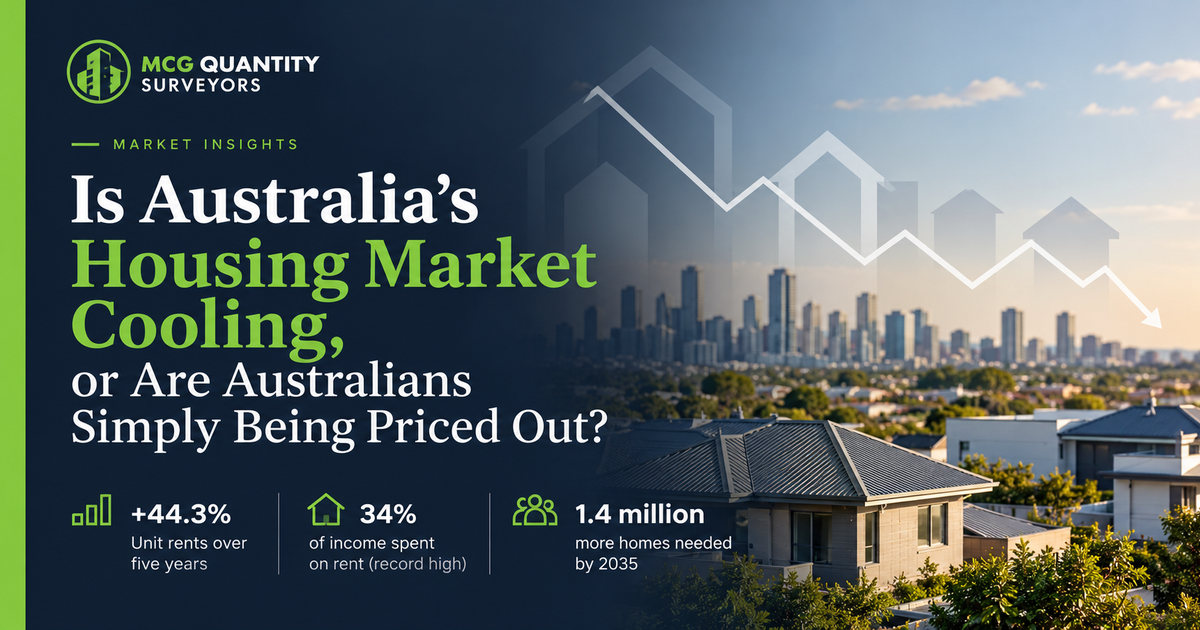
According to Cotality’s October Quarterly Rental Review, national unit rents have increased by 44.3%, equivalent to another $208 per week.
That’s approximately $10,816 a year.
House rents have increased by 36.6%, or around $195 a week.
Meanwhile, Cotality reports that rental households were spending approximately 34% of their pre-tax income on rent as at June, the highest proportion on record in its affordability data.
There is only so much money in a household budget.
At some point, people simply cannot absorb further increases without making significant compromises elsewhere.
And when they reach that point, something interesting happens to the economics of the rental market.
People adjust their living arrangements.
A 28-year-old who would ordinarily be looking for their own apartment might continue living with their parents.
Two couples who would prefer to live independently might share a house.
Someone who previously rented an apartment might move into a rooming house.
A family might relocate further away from employment, schools or relatives because suitable accommodation in their preferred area is no longer affordable.
At the more serious end of the spectrum, people can find themselves experiencing overcrowding, housing insecurity or homelessness.
These aren’t necessarily signs that Australians need fewer homes.
They may be signs that Australians cannot afford the homes they actually need.
The hidden housing shortage
Here’s where the economic consequences become particularly interesting.
Imagine two young adults who would ordinarily rent separate apartments.
Both have jobs. Both would prefer to live independently. Both represent potential demand for rental accommodation.
But neither can afford the rent.
Instead, they remain living with their respective parents.
The rental market now has two fewer prospective tenants competing for individual properties.
Measured demand has softened.
Yet the underlying desire for two additional households hasn’t disappeared.
Those households simply haven’t formed.
Economists distinguish between underlying housing need and effective housing demand. The latter is influenced by the financial capacity of households to participate in the market.
And there’s growing evidence that housing affordability is changing the way Australians form households.
The National Housing Supply and Affordability Council’s State of the Housing System 2026 report found that Australia’s average number of adults per household increased from 2.08 in July 2024 to 2.10 in July 2025.
The Council specifically identified affordability pressures and adult children remaining in the family home for longer as contributing factors.
That might seem like an insignificant movement.
But across millions of households, relatively small changes in average occupancy can influence the demand for enormous numbers of separate dwellings.
And the implications extend beyond property statistics.
Delayed household formation can affect relationships, independence, family planning, employment opportunities and quality of life.
Living with family or sharing accommodation can be entirely positive when it’s a genuine choice.
It’s rather different when people have no financially viable alternative.
A rising rental vacancy rate doesn’t tell us how many people have abandoned their plans to live independently because they can no longer afford to do so.
That’s a blind spot worth paying considerably more attention to.
Falling property prices create another problem
The ownership market is experiencing a similar affordability constraint.
Cotality estimates that four interest rate increases since February 2026 have reduced the borrowing capacity of a median-income household by approximately $90,000, or 9%.
Those households haven’t suddenly decided they no longer want to own a home.
They simply have less capacity to purchase one.
And while weaker property prices can provide an important benefit to aspiring homeowners, there’s another side to that equation.
A decline in established dwelling values doesn’t necessarily make it cheaper to construct a new dwelling.
From our perspective at MCG Quantity Surveyors, this distinction is fundamental.
The ABS reported annual house construction output price inflation of 5.9% in the June quarter of 2026.
Construction costs remain exposed to labour availability, materials, transport, regulatory requirements and project complexity.
Meanwhile, developers must also account for land acquisition, financing, professional fees, statutory contributions, holding costs and commercial risk.
If achievable selling prices weaken while those costs remain elevated, some projects become less financially viable.
A developer might have planning approval for 100 apartments.
The population might desperately need those apartments.
But if the expected selling prices won’t cover the cost of delivering them, the project may never proceed.
You can’t live in a development approval.
You need someone to finance and construct the building.
We’re still not building enough homes
The latest ABS Building Activity data illustrates the scale of the challenge.
Australia commenced 52,201 dwellings in the June quarter of 2026 and completed 47,168.
Both figures represented quarterly improvements, which is encouraging.
But annualising the latest quarterly completion figure produces a pace of approximately 189,000 dwellings per year.
The National Housing Accord’s five-year target requires an average of 240,000 new homes annually.
That comparison is only illustrative, as one quarter doesn’t determine the annual outcome. Nevertheless, the challenge is obvious.
The National Housing Supply and Affordability Council projected approximately 980,000 new homes during the Accord’s five-year period, below the 1.2 million target.
And Cotality’s October research estimates that Australia will require approximately 1.4 million additional homes by 2035.
There is a considerable difference between acknowledging the need for more housing and creating the conditions in which enough housing can actually be delivered.
Could our policy responses create unintended consequences?
This becomes particularly relevant when we consider recent changes to the taxation of residential property investment.
The 2026 federal budget reforms are designed, in part, to encourage investment into newly constructed housing rather than existing dwellings.
There’s a reasonable policy argument for doing that.
Additional investment in genuinely new housing can support the expansion of dwelling supply. And reducing investor competition for established homes may improve purchasing opportunities for some owner-occupiers.
But the outcomes aren’t guaranteed.
What happens if new housing is already too expensive to construct in the locations where it’s needed?
What happens if investors reduce their participation in the established rental market faster than new rental dwellings are completed?
And what happens if weaker achievable sale prices further undermine development feasibility?
These are questions that require evidence, rather than assumptions about how investors, builders or renters will respond.
Tax incentives can influence investment decisions. But they cannot independently resolve labour shortages, high construction costs, infrastructure constraints or the commercial feasibility of new development.
We need to measure whether the changes actually deliver more homes, improve affordability and produce better outcomes for renters and buyers.
We need better measures of housing success
I don’t think anyone should be disappointed to see slower rental inflation or lower property prices.
For many Australians, those outcomes offer some desperately needed relief.
Nor should we assume that every increase in household size represents hardship. Household composition changes for many reasons, including preferences, culture, relationships and population growth.
And slower migration is also contributing to the moderation in rental demand.
But these qualifications don’t diminish the central concern.
We need to distinguish between housing becoming more affordable because supply is meeting demand, and housing demand weakening because Australians can no longer afford to participate.
Those are fundamentally different outcomes.
We should be measuring whether people can afford appropriate accommodation.
Whether young adults can form independent households when they choose.
Whether overcrowding and housing insecurity are reducing.
Whether approvals are becoming commencements, and commencements are becoming completed homes.
And whether the economics of residential construction are improving sufficiently to deliver the supply Australia needs.
Because we may be approaching a rather uncomfortable situation.
We can have falling property prices, slowing rental growth, increasing vacancy rates and a substantial housing shortage simultaneously.
And if weaker market conditions make new construction less feasible, today’s apparently improving affordability statistics could conceal tomorrow’s housing supply problem.
Sometimes a market isn’t cooling because everyone’s needs are being met. Sometimes it’s cooling because people simply can’t afford to participate.
That’s a distinction our housing debate cannot afford to ignore.
Sources and further reading
- Cotality, Rental growth loses momentum as vacancy rates rise (9 October 2026)
- Cotality, Monthly Housing Chart Pack (October 2026)
- National Housing Supply and Affordability Council, State of the Housing System 2026
- Australian Bureau of Statistics, Building Activity, June 2026
- Australian Bureau of Statistics, Producer Price Indexes, June 2026