3 strategic factors that influence the TDS for your investment property

Every property investor should be claiming depreciation deductions via a tax depreciation schedule.

An investment property tax depreciation schedule is a summary of the tax deductions you can claim for the depreciation of your investment property’s structural elements (such as bricks and concrete) and “plant and equipment” components (such as blinds, air conditioning and carpets).

When compiling a tax depreciation schedule, your Quantity Surveyor will want to take the following three strategic factors into account:


How long do you plan to hold the property?

Two different methods may be used to calculate the amount of depreciation claimable during any given year. In order to choose which method is best for your situation, your Quantity Surveyor will prepare a report showing both methods. On top of this, it is often possible to prepare the report with a focus on higher deductions upfront. To maximise deductions up front, or indoor over the latter years, the Quantity Surveyor will want to know how long you plan to hold your investment property.

The Prime Cost method spreads depreciation fairly evenly over the life of the building, and is ideal if you intend to hold your investment property for the long term, while the Diminishing Value method assumes higher depreciation rates, but the residual value declines more rapidly. The Diminishing Cost method can benefit investors planning to hold an investment property for a shorter term, usually five years or less.

Your overall property investment strategy will dictate how your Quantity Surveyor approaches your depreciation schedule.


Has the property been renovated? Are you planning any renovations?

If your investment property has recently been renovated or improved, your Quantity Surveyor will want to capture all “new” items to ensure you’re claiming maximum tax deductions.

If you’re planning renovations or improvements be sure to have your Quantity Surveyor inspect your property before you start. Items such as old carpets, kitchens appliances and the like will usually have a residual value that you can claim as a tax deduction – even if you’re throwing them out. Once renovations are complete, have your Quantity Surveyor complete an updated tax depreciation schedule that captures the value of new assets to be depreciated. This can sometimes be achieved within the one schedule.


Are you the only owner?

Investment property co-owners can maximise depreciation claims by having a split depreciation schedule compiled. Depending on your situation, a split depreciation schedule may help you (and your co-owner/s) qualify for a higher rate of depreciation or allow you to write off plant and equipment items faster, substantially increasing the dollars in your pocket come tax-time.

An effective tax depreciation strategy can substantially improve the performance and profitability of your investment property.   Speak to your accountant and Quantity Surveyor about these three factors to ensure you’re getting the most out of your investment.

Five items your tax depreciation schedule shouldn’t overlook

A tax depreciation schedule lists an investment property’s depreciable building, plant and equipment items and will allow you to claim these depreciation expenses as tax deductions.

While obvious features such as walls, carpets and bathroom fittings are always included in tax depreciation schedules, don’t overlook these five not-so-obvious depreciable items:


  1. Common property items within strata apartments and units

A tax depreciation schedule for an apartment or unit will list all depreciable building and plant elements within the actual unit (doors, kitchen fittings and so on).  The schedule should also include your portion of common property items outside the unit’s front door, such as the entry foyer, basement, air conditioning, lift, fire extinguishers, ventilation and hot water system.


  1. Outdoor elements

Common outdoor elements should also form part of the depreciation allowances, including fences, paths, swimming pools (where they qualify), BBQ areas, and “hard landscaping” items such as retaining walls and pergolas.  Be aware that you can’t claim “soft landscaping” ie. Turf, plants, mulch etc.


  1. Scrapping of items made obsolete during renovations

When completing a renovation you may be able to claim the scrapping value of obsolete items you’re getting rid of.  The scrapping (or residual) value of an item is its estimated value at the end of its useful life.

Have a Quantity Surveyor prepare a schedule prior to the renovation works, that will ensure you’re able to claim for anything that you’re throwing away. The resulting tax deduction you’re entitled to will be based on the “loss” you incur by throwing out old carpets, kitchens appliances and other assets.


  1. Design & professional fees

Fees paid to design and development professionals can be claimed within your tax depreciation schedule as part of the total construction cost. For new builds, include costs for architects, engineers and designers when compiling information for your Quantity Surveyor.


  1. Council costs associated with renovation or new build

Council permits, application fees and a portion of the costs a developer might spend on infrastructure (e.g. footpaths, gutters and community playgrounds) can also be included in your tax depreciation schedule.

Tax deductions can make or break an investment property’s financial performance.  By engaging a registered Quantity Surveyor to compile a professional tax deprecation schedule you can literally save thousands of dollars.  Don’t invest in property without one.

How to use investment property tax depreciation to maximise cash flow

Investment property tax depreciation allows you to claim a tax deduction for the wear and tear of the structural elements (the actual building) and plant and equipment (fixtures and fittings) of an investment property.

By claiming depreciation as a tax deduction you can lower your taxable income. This in turn reduces the amount of income tax you need to pay, leaving more cash in your pocket each year. You can use this increased cash flow to pay down debt, create new investments or simply enjoy more disposable income. It’s fantastic!

You can maximise investment property tax deductions by considering the following:

  1. Engage a registered Quantity Surveyor

To maximise investment property tax deductions you need a detailed tax depreciation schedule. A tax depreciation schedule summarises the tax deductions you can claim on your investment property each year for up to 40 years. ATO rules insist that a tax depreciation schedule be compiled by a registered Quantity Surveyor, who will inspect your property and ensure that every depreciable item is identified, evaluated and included in your depreciation schedule.

  1. Claim small items immediately

To offset the usually higher cost of an investment property in initial years, claim small items as soon as possible. Items not part of a set under and under $301 dollars can be written off immediately, as can your portion of common costs relating to strata units, such as things like door closers, lighting, carpets and a number of assets as long as they’re also under $301 dollars.

  1. Furnish your investment property

Furnishing a property can often help achieve a higher rental return. Even better, furniture in an investment property is depreciable and you can claim a large chunk of it in the first year. Speak to your accountant and property manager about whether this is a profitable option for your property.

  1. Claim scrapping value when upgrading or renovating

Scrapping, or residual value, is a depreciable element that many property investors miss. You can claim a tax deduction for fixtures and fittings that are replaced during an upgrade or renovation. Have a Quantity Surveyor review your renovation plans and estimate what you will “lose” when throwing out old carpets, kitchen cabinets or other fittings. This “scrapping” amount can be claimed as a tax deduction.

Claiming depreciation expenses at tax time can put a LOT of money back in your pocket. Speak to a Quantity Surveyor about your investment property and get your extra cash flow working for you.

Four times you can benefit from a tax depreciation schedule

A tax depreciation schedule itemises the tax deductions claimable for depreciation of an investment property. It lists the amounts you can claim each year (for 40 years) for the wear and tear of capital works – the actual building – and the wear and tear of plant and equipment – elements within the building such as furnishings and electrical appliances.

A depreciation schedule can add significant value at these four stages of the property investment process:


  1. Before you buy

A savvy investor will evaluate a potential property investment using a full financial picture: potential income, expected expenses and tax deductions claimable – including deductions for depreciation. If you’d like to know whether depreciation deductions will add considerably to the profitability of your potential investment, arrange for a Quantity Surveyor to complete a Tax Depreciation Estimate. This document will outline the deductions you can expect to claim, helping you make a more educated investment decision.


  1. After settlement

Claiming allowable depreciation deductions should be on the “to do” list for every investment property. Ideally you should have a Quantity Surveyor inspect your property and prepare a tax depreciation schedule as soon as possible after settlement. They can then forward the document directly to your accountant and you’ll be claiming every depreciation dollar you’re entitled to. It couldn’t be easier.


  1. When planning renovations

Investment property renovations may incorporate “scrapping costs” – the writing off of old fittings, fixtures and appliances. A Quantity Surveyor can advise whether your new kitchen, extension or property makeover presents an opportunity to increase the depreciation deductions claimable on your property. It’s definitely worth asking.


  1. When preparing to sell

A professionally prepared tax depreciation schedule can be a valuable marketing tool when selling any property. Potential investors will consider location, capital growth, return on investment and the tax implications of purchasing your property. Why not showcase your property by presenting a full financial picture to potential buyers? It may be key to securing the sale price you’re after.

Commercial property owners AND tenants can benefit from depreciation

As a commercial property owner or a commercial tenant, you can benefit by claiming tax deductions for commercial property depreciation.

Whether you’re collecting or paying rent, a tax depreciation schedule should form part of your business planning. A commercial property depreciation schedule will list tax deductions you can claim for depreciation of capital works and the wear and tear of plant and equipment.

Capital works include the actual building: bricks and mortar, walls, wiring, floors and other permanently fixed items.

Plant and equipment covers items that have been installed within the building, such as furniture, shelving, appliances, bathroom fittings, air conditioners, carpets & floor coverings, window coverings and any specialist equipment required to do business.

So who can claim what?


Commercial Property Owners

A commercial property owner can claim a depreciation deduction for capital works – the structural elements of a premises – with the amount depending on the property’s age and value.

An owner can also claim a depreciation deduction for plant and equipment they have purchased and/or installed.


Commercial Property Tenants

A commercial tenant can claim a depreciation deduction for items they have purchased and installed within the building.

A tenant may also be able to claim a deduction for “scrapping” when vacating a commercial property, particularly if they are required to return the property to its original condition at the end of a lease.

How much can I claim?

A tax depreciation schedule will itemise yearly deductions claimable for the life of the building (up to 40 years). The ATO requires that a registered Quantity Surveyor inspects your premises and completes a tax depreciation schedule that can be forwarded directly to your accountant or financial planner.

A tax depreciation schedule is a must to ensure you’re claiming every depreciation deduction you’re entitled to. Maximising tax deductions means more money in your pocket at tax time – something that’s sure to appeal if you’re leasing a business premises, or if you own the building.

Timely reminder to home owners – Watersun Homes Collapses

The headlines are reading, ‘Home builder goes under, Thousands lost, Hundreds of home owners left out of pocket’.

The reality is that we have all read these headlines before and unfortunately, these brutal words will continue to feature from time to time within the construction landscape.

Building your home is a personal thing, whether it be the family home or an investment. Like our health, we live by the adage that ‘it will never happen to me’.

Wrong. As recent as this week, some 300 home owners are expected to be left out of pocket with the collapse of Watersun Homes.

As the Geelong Advertiser reported on the 1st March, the directors of Watersun have gone into hiding, whilst the home buyers have been left in shock.

I expect the question on the minds and lips of many of the 300 home buyers after Watersun’s collapse will be, What to do next?

Know your numbers. What have you paid in construction cost progress payments to the builder?  What is your cost to complete the construction works?. Then, are these numbers correct?

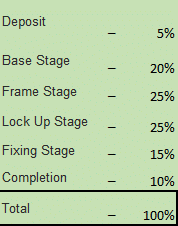
You may well have been paying the builder under a milestone method or staged method, similar to the below. However, that may well be very different to the ‘actual’ cost of the works completed to site.
Ms blog - MCG Quantity Surveyors

For example on your $400,000 construction cost, you have paid the builder up to and including the frame stage. That is some 50% of the contract sum, $200,000.

However, what has actually been completed to site would be more in the order of 25% or $100,000.

Why? The above milestone method is front loaded to allow the builder to pay deposits for building materials, suppliers and subcontractors. In many cases, these deposits and building materials have not even been provided yet, or have reached site.

In a nut shell, you have $200,000 left as your cost to complete, but that will not be enough to complete the project, you actually would need closer to $300,000, plus the cost of a new builder establishing to site, engineer’s inspections, etc.

My advice? Contact a Quantity Surveyor to estimate the actual construction cost, then conduct a site inspection to determine the actual cost of the works completed and fixed to site. This will give you an accurate ‘actual’ cost to complete the development.

Secondly, you have the option of insurance. This is why it is vital that your home builder provides copies of these to you. I’m referring to Home Owners Warranty Insurance.

A word or warning though, going down the rabbit hole of insurance, will be a slow and at times, tedious process.

Choice, Australia’s leading consumer advocacy group, noted that:

“If your builder does go broke, die or disappear before the complaint is resolved and you have to resort to your home warranty insurance, it won’t cover legal costs against the builder. These costs can easily exceed the amount you’re attempting to recover – in one case cited by the Consumer Action Law Centre, a claim for $63,000 incurred about $90,000 in legal fees.

In addition, Choice went on to note “The Victorian Managed Insurance Authority has reported that Victorian homeowners paid about $87.8m in home warranty insurance premiums from May 2010 to May 2011, but only $108,000 was paid out on a total of three successful claims. Over the same timeframe, about 250,000 Victorians suffered damage at the hands of Victorian home builders”.

Thirdly, if patience can be maintained, a potentially better prospect will be to hold out and let the dust settle. There would be a good chance that a knight in shining armour is around the corner. This knight may be another building company willing to take on the task of finishing the buildings and continue to lead you on the path of having a completed project.

Regardless, knowing your numbers will be vital. If you are wanting to and willing to negotiate with the new builder, you will need to know what the ‘actual’ cost of the remaining works are.

My advice? Get hold of a qualified Quantity Surveyor and ‘KNOW YOUR NUMBERS’.

Marty is a founding director of MCG who specialise in traditional construction cost estimating and maximising the depreciation deductions for property investors and businesses across Australia.Marty has over 18 years experience in the building and construction industry. Marty has been called upon many times as an expert witness, sits on the interviewing panel for Australian Institute of Quantity Surveyors (AIQS) and works closely with financiers and developers across Australia.

The Melbourne Residences – Rippling Facades and Ripping Deductions

If there’s one thing we love, it’s repeat clients. Obviously, it’s great to do another schedule and that they trust us as the depreciation experts, but what excites us more is that our investor clients and building their portfolio and hopefully dramatically changing their retirement lifestyle in the process.
This repeat client bought a unit in South Brisbane. Before you retort with issues of oversupply, this development is a little different, in fact, the apartments sold out within 7 days.

Dd 300x166 - MCG Quantity Surveyors

We’re talking about the Melbourne Residences at 109 Melbourne Street, South Brisbane. This $105 million-dollar development consists of 178 residential apartments over 24 levels. Designed by Tony Owen Partners Architects, the development includes a resident’s rooftop club with a stunning pool, BBQ area, fitness centre, dining room and cinema with gold class theatre chairs.

According to the General Manager Mr Zeyad Imam, “The Melbourne Street façade is inspired by the rippled patterning which has its roots in the undulating shapes of the Convention and Exhibition Centre across Melbourne Street. The ripples across the façade offer a distinctive sculptural expression reflecting this prestigious site.”

 The building was constructed using a concrete frame with post-tensioned slabs, a full glass and aluminium facade on the Melbourne St frontage and a Glass and concrete finish on the balance of the building.

As for depreciation deductions, the extensive common area and high standard finishes supercharge the depreciation claims for this development. The one bedroom apartments range from around $13,000 to $16,000 worth of deductions within the first full year of claim, with two bedroom and two bathroom units closer to the $20,000 mark within the first full year of claim.

The Melbourne Residences 195x300 - MCG Quantity Surveyors

Four reasons you should always use a construction price estimator

So you’ve decided to build. You’ve had plans drawn up and you have a ballpark budget in mind, but how can you be sure that it’s realistic? With a professionally-generated cost estimate, that’s how.

Here are four reasons you should employ a construction price estimator before you get started:


  1. Belief in your budget

An accurate budget requires research into the cost of every element of construction – every material, every tradesperson, every resource and every fee to be paid.

A professional construction estimator has accurate, up-to-date knowledge of material and labour costs, fees and other elements of construction – so their estimate won’t contain any guess work. You move forward feeling confident that you won’t blow the budget.


  1. Get started sooner

A construction price estimator with up-to-date tools, connections, experience and expertise will complete an estimate MUCH faster than will. Gathering all the required information yourself can take weeks – and that’s if you know what you need and where to find it.


  1. Successfully secure finance

When presented to a lender, a professional cost construction estimate can help you secure finance. Lenders love professional price estimates as they provide an accurate assessment of risk. A reliable cost estimate gives you better leverage when arranging finance and will help you negotiate the terms and conditions of your construction loan.


  1. Enjoy piece of Mind

No guesswork. No wishful thinking. No nasty surprises. Being confident that construction will be on time and on budget is a great place to start any project. A cost construction estimate really is an essential first step for a successful and stress-free build.


How do I get a construction price estimate?

When your working drawings are complete take a copy of the building plans and specifications to a Cost Construction Estimator or Quantity Surveyor.   They will review the plans and use their expertise and current market data to provide a detailed construction estimate outlining all the costs involved. If the estimate fits your intended budget, then you can apply for finance and get building. If not, you’ll have an accurate road-map for fine-tuning your building plans to suit.

How an investment property depreciation schedule will put money back in your pocket

An investment property depreciation schedule is basically a summary of the tax deductions you can claim for the depreciation of your investment property. This can include structural elements like bricks and concrete and also “plant and equipment” components such as ceiling fans, blinds and the dishwasher. Each depreciable item is evaluated to figure out how long it will last and how much depreciation can be claimed against it for each year of its life.


Why do you need a depreciation schedule?

So you pay less tax. Claiming depreciation on your investment property will lower your annual taxable income, and therefore your tax bill. A depreciation schedule maps out the deductions you can claim for up to 40 years and can put a significant amount of money back in your pocket.


How do you get an investment property depreciation schedule?

Call a Quantity Surveyor. To maximise your tax depreciation entitlements, and to comply with ATO rules, your investment property depreciation schedule must be prepared by a qualified, registered Quantity Surveyor.

They will physically inspect your property to evaluate and record all depreciable items and they will conduct any searches required (via local council, property agents or strata managers) to build a full picture of your property’s history. Using this information, they’ll prepare and present a detailed summary of the depreciation amount you can claim on your tax return each year.


Insider tips for using your investment property depreciation schedule

  • Have your Quantity Surveyor send the schedule directly to your accountant. Looking after your investments should be a team effort.
  • Don’t forget to claim the cost of preparing the actual schedule.
  • Ideally, have a depreciation schedule completed straight after settlement and before a tenant moves in. This lets your Quantity Surveyor see the property in its “original condition” and it saves you having to coordinate inspection times with a tenant.
  • Don’t discount older properties. You can claim depreciation of both structural and plant elements of properties built after 1987, and for properties built before 1985 you can claim depreciation of plant and equipment. You may even be able to claim depreciation on a previous owner’s renovations.
  • Just get it done. An investment property depreciation schedule really is a one-off expense that pays for itself and can save you thousands of dollars throughout the life of your investment.

181 Fitzroy Street, St Kilda – Super depreciation, and a pool to die for.

The view from St Kilda back to the CBD over Albert park is not often showcased, but it’s a spectacular one. Taking full advantage of this is the new development at 181 Fitzroy Street St Kilda. This retail/residential mixed use building comprises 46 two bedroom and 68 one bedroom apartments over nine levels.

As described by SJB architects, “the building addresses the eclectic and diverse streetscape of the boulevard with a dynamic composition of light coloured facade panels that simultaneously provide protection from the western sun and frame the stunning views from within the apartments.”

Pace Development sold the penthouse for this development for $4.8 million.

As far as common areas are concerned, this is where the building really soars. Residents are treated to a landscaped rooftop pavilion, outdoor entertaining and a gym. However, none of the project photos can compete with the 25m infinity lap pool perched on top of the building, gazing back towards the CBD.

181FitzroyStreetStKilda e1484279600983 300x149 - MCG Quantity Surveyors

We were commissioned by investors to provide tax depreciation schedules within the premises, as several the units will be available for rental.

Supercharging the deductions were the common lifts, solar panels and air conditioned common areas, as well as integrated high-quality appliances and floating timber floors. Two bedroom investors can expect deductions starting at over $15,000 within the first full financial year.

181FitzroyStreetSTKildaVIC 195x300 - MCG Quantity Surveyors