The Top Five Reasons Why Your Construction Cost Estimate Is Likely to Blow Out

With house prices sky-rocketing in the past twelve months, many people are now looking at other options for getting into the residential property market.

While house and land packages are still popular, increasingly people are looking at substantially renovating their own properties, or even buying old properties and renovating or rebuilding.

These are all great options, but like anything, they come with their own set of risks and challenges.

For the uninitiated renovator or first time developer, there’s a multitude of hidden costs that can derail even the most cautious planner.

It’s hard to calculate an accurate construction cost if you don’t know what to look for.

So what are the top five things to be aware of?


  1. Interest rate increases

We’ll put this at the top, not because it’s the most important – although in some instances it may be – but because it’s the most topical right now.

With the recent decision from the Reserve Bank to move the cash rate from 0.10% to 0.35%, the cost to borrow money is going to escalate.

The major banks have already moved to increase interest rates.

This may impact your construction cost for any number of reasons.

It will increase your cost of capital if you’re borrowing to fund the project.

It may increase your contractor prices depending on their level of debt funding.

And if you encounter any delays (which we talk about more below), it will have an impact on your holding costs.

Of course, the whole reasoning for the RBA to increase the cash rate is to put a handbrake on the economy and slow the rate of inflation.

Which may have the result of reducing other components of the construction cost.

It already appears to have slowed down the housing market boom, however at this stage the evidence is all anecdotal.

Only time will tell if the measures have the desired effect.


  1. Cost escalation on materials

We wrote in an earlier article about the many, often complicated, reasons for the rising costs of building materials.

To recap briefly,  the cost of timber and steel was already well on the rise during the pandemic, resulting largely from global logistical issues and shortages in the manufacturing sector.

This has since been compounded with the war in Ukraine generating economic sanctions on Russian oil. Not only that, the industry is further impacted by the fact that Russia is the largest exporter of soft timber globally.1 Sanctions on timber leads to higher prices on raw and finished materials.

Of course the rising prices at the petrol bowser has caused transport and logistics to become more expensive and concrete prices are spiking because the manufacturing process relies on cement, and making cement requires large amounts of energy in the heating process.

All these increases combined can have a substantial impact on the project cost. A good construction cost calculator needs to be flexible enough to allow for cost increases without producing an artificially inflated cashflow (in either direction) that shows the project to be unfeasible. Unless of course the numbers really don’t stack up.


  1. Inclement weather

It’s no surprise to anybody that’s we’ve experienced an unseasonably wet summer in many parts of the country.

According to the Bureau of Meteorology, this weather event has been part of the La Niña event that has impacted Australia for the past six months and is now said to be weakening.

La Niña means “little girl” in Spanish and simply refers to “a cold event”. In Australia, La Niña increases the chance of cooler daytime temperatures, reducing the risk of heatwaves and bushfires and tends to create wetter than normal conditions, increasing the frequency of tropical cyclones and flooding.

In addition to the devastating damage and flooding caused by the recent weather events, there has been significant stress placed on anyone trying to build or undertake a substantial renovation over the past six months. Not only has the ongoing weather caused extended construction delays, it has also had flow on effects for deliverability of materials, and supply issues for contractors with increased demand across the board.

All of this on top of an already struggling supply system as a result of two years of a global pandemic.

These delays almost inevitably lead to additional construction costs. If the house is not ready on time, you may have to live somewhere else for a period of time. You may have to store furniture or belongings, or even building materials.

If the property is an investment you may have additional holding costs and have an extended period without income.


  1. Delay on materials

If you’ve been to a grocery store recently it’s hard to miss the empty sections where your favourite grocery items used to be.

We’ve seen an improvement in the last couple of months but there are definitely still shelves with limited stock, largely due to issues with logistics and freight movements both into and around the country.

These logistics issues are not limited to grocery items. With restricted travel and border closures until very recently, this has had an impact on movement of raw materials leading to a backlog of deliveries which will take some time to overcome.

It’s a bit hard to finish a new build or even a renovation on time if you can’t get the garage door or floor finishes that you want, let alone the appliances that you had on special order from Germany, or even the marble tiles from Italy.

There’s an argument here for choosing locally made items as far as possible, but even then getting them shipped around the country in time can be problematic.


  1. Availability of contractors

I spoke to one person recently who is trying to book in repairs to their driveway following the floods. They’ve had an assessor attend after a four week wait, and it turns out the works are worse than thought. They had minimal inundation through their downstairs rumpus room which needs to be completely stripped. They tried to book in repairs only to find they can’t get a painter for another six months!

The national housing shortage is causing unprecedented demand for new housing stock, even before extensive repair work required to fix flooded houses, and contractors are proving difficult to pin down.

A shortage of skilled labour is not only causing delays on projects, but also leading to increased labour costs in a classic case of supply versus demand.


How can MCG help?

We write all this, not to scare you off building or renovating.

On the contrary, working on a new project can and should be an exciting time for all involved.

But you do need to be prepared with a realistic timeframe for the works, as well as a robust construction cost calculator to ensure you are forewarned and able to plan your cashflow.

That’s where MCG Quantity Surveyors can help.

MCG Quantity Surveyors are acutely aware of the current challenges faced by our clients when it comes to planning and assessing their property projects. We make it our priority to ensure our reports take into account all possible cost implications.

We may not be able to control rising prices or materials shortages, but we can definitely help you calculate your construction cost.

We think that’s a pretty important step.

Contact us now for an obligation free quote on 1300 795 170 or go to our website mcgqs.com.au for more information.


References


1 Merlehan, Adam  “The real reason why construction giants Condev and Probuild collapsed”  22 March 2022 <SmartCompany.com.au>


There’s No Silver Bullet for Rising Building Costs, but Having a Detailed Construction Cost Estimate is a Good First Step

It’s been tough reading the news lately.

Recent coverage of the war in Ukraine and the devastating impact of the floods in Queensland and New South Wales has pushed reports of COVID cases and lockdowns down the rankings, at least for the time being.

It’s enough to make us yearn for the daily briefings from the State Premiers.

Almost, but not quite.

Far from the optimistic resolutions of 31 December, 2022 has gotten off to a rocky start on many fronts. With rising costs across the board, it seems nobody is being spared, least of all the development and construction sectors.

Fueled by ongoing low interest rates and government incentives, demand for housing and new developments continues unabated, running headlong into multiple supply issues.

It takes a steady hand and a firm grasp of economic factors to navigate the current volatility in the property industry.

Even then, there’s no guarantee.

The spate of construction companies under severe financial stress seems to be on the rise.

Unfortunately some sizable and respectable companies such as Probuild and Condev have already fallen victim to the headwinds threatening the sector, and the fallout is likely to be far-reaching.

As hard as it is to read about, it’s a lot worse for the people actually at the heart of these stories.

Faced with fixed cost contracts struck months ago now entering execution phase, it’s unlikely we’ve seen the end of the pressure on the sector.

In these uncertain times, having a robust and reliable detailed construction cost estimate is more important than ever.

So why are costs rising?

The cost of timber and steel was already well on the rise during the pandemic, resulting largely from global logistical issues and shortages in the manufacturing sector.

This has now been compounded with the war in Ukraine generating economic sanctions on Russian oil. Not only that, the industry is further impacted by the fact that Russia is the largest exporter of soft timber globally.1

We’re all bearing witness to rising prices at the petrol bowser with a full tank of petrol hitting the back pocket of everybody.

Transport and logistics becomes more expensive. Sanctions on timber leads to higher prices on raw and finished materials. Concrete prices are spiking because the manufacturing process relies on cement, and making cement requires large amounts of energy in the heating process.

The flow on effects are endless.

Why are construction companies going under?

The construction industry has always been competitive. More often than not, builders bear the risk of price movements and inclement weather via fixed price, lump sum contracts. With minimal profits, often less than 5%, already factored in, it doesn’t take much of a bump to move the project from black to red.

Bring on a La Nina weather event, or a war in Europe causing macro-economic ripples felt across the world, or a global pandemic causing supply shortages and transport delays, it appears to be a perfect storm.

Even with continued demand driven by low interest rates and government incentives, growing revenue streams are not converting to profitability in many cases, and supply issues and materials cost increases do not look to be abating quickly

How can MCG help?

We know that not every builder is operating on the scale of Probuild and Condev. But regardless of size, it’s just as important to know exactly what costs you’re up against and understand how quickly they can move.

With the help of a detailed construction estimate template we can work with you to determine your costs ahead of time and stress test for likely supply chain movements.

Or even the unlikely ones.

MCG Quantity Surveyors are acutely aware of the demanding and competitive nature of the construction industry. We make it our priority to ensure turn-around times are consistently met and that our clients are kept up to date with the status of projects and reports.

We may not be able to control rising prices or materials shortages, but we can definitely help get a firm handle on your detailed construction cost estimates.

We think that’s a pretty important step.

Contact us now for an obligation free quote on 1300 795 170 or go to our website mcgqs.com.au for more information.


References


1 Merlehan, Adam  “The real reason why construction giants Condev and Probuild collapsed”  22 March 2022 <SmartCompany.com.au>


Why You Need to Understand Your Commercial Construction Cost Well Before You Break Ground

If you’ve been paying attention to your superannuation or share portfolio balance over the past few weeks you’ve probably noticed the Australian stock market has had a bumpy ride.

There’s many reasons for that, but one worth noting in relation to the property market is the current volatility in iron ore, steel and lumber costs.

We typically think of the property sector and the stock market to be mutually exclusive investment decisions (unless of course you’re investing in listed property trusts, and that’s a whole other topic).

The purpose of this article is not to talk about the stock market. There are plenty of resources and more qualified commentators to discuss that topic.

But whilst you might have noticed the fluctuations in the ASX, the follow on impact of these rising prices on the construction industry and commercial construction cost is sometimes a little harder to fathom.

In a recent article in the Australian Financial Review back on the 1st December 20211 , Rich Lister Harry Triguboff was quoted as saying “The building costs are going up a lot…It’s not a matter of the labour force asking  for a 5 per cent increase. Iron Ore prices have come down, but steel has gone up. And it’s going up by a lot, not by 2 per cent – [but by] 10-20 per cent. It’s going up a great deal.

The same article noted property leaders, Dexus CEO Darren Steinberg and Lendlease CEO Tony Lombardo, addressing the rising costs of lumber and steel.

“This is going to put price increases on construction,” Mr Steinberg said.

Unfortunately recent media coverage of building companies struggling with solvency issues only highlights the difficulties in the development sector as a result of increasing commercial construction costs.

The other challenges of staff shortages and logistics delays that are being felt across all sectors as a result of COVID have only served to exacerbate the issues.

It’s more important than ever for anyone operating in the development space to have clear feasibility analyses and a robust commercial construction cost breakdown.

It’s not just the current cost of materials that need to be considered.

With heavy speculation that interest rate increases are becoming inevitable, it’s likely that the cost of capital will soon increase.

Not only that, there is current volatility in the retail, housing and commercial office sectors.

Return to work options and the ongoing debate regarding the take up of commercial office space has valuers scrambling to determine the correct metrics on which to base their assessments.

Retailers face a constant battle of staff shortages and COVID outbreaks impacting consumer demand.

It’s not all bad news though.

The housing market continues its strong trajectory, strengthened by opening boarders and the low interest rate environment.

Whilst it appears to have come slightly off the boil, demand is still strong and looks set to continue for some time yet.

So what does all this mean for commercial construction cost?

Developers can’t afford to get their budgeting wrong.

Whether it’s office, housing, retail, industrial.

There’s too much riding on it.

Before a project budget or feasibility for a proposed development is even considered, it is imperative that a preliminary cost plan be completed.

This report will typically be based on cost allocations per square metre of the Gross Floor Area (GFA) of the development. This is largely due to the preliminary nature of the design and documentation at this point.

The Preliminary Cost Plan will establish a working budget for each project element (substructure, columns, external walls, internal walls, floor finishes etc). The Plan forms a valuable assessment tool in the design decision-making process.

MCG Quantity Surveyors are acutely aware of the demanding and competitive nature of the construction industry. We make it our priority to ensure turn around times are consistently met and that our clients are kept up to date with the status of projects and reports.

We may not be able to control the stock market, but we can definitely help get a firm handle on your commercial construction costs.

We think that’s a pretty important step.

Contact us now for an obligation free quote on 1300 795 170 or go to our website mcgqs.com.au for more information.


References


1 Bleby, Michael “Rising costs a risk for developers and builders: Triguboff” 1 December 2021 <afr.com

Set your project up for success with a reliable construction cost estimate

Imagine you are building your dream house.

The one you’ve been thinking about for as long as you can remember.

The whole family is on board.

You know how many bedrooms and bathrooms it needs to put an end to shared rooms and bunk beds.

You’ve included a butler’s pantry, and a walk-in robe, and a kitchen that would have Gordon Ramsay excited.

You have vision boards and colour schemes and finishes charts.

You can picture long family lunches and cosy movie nights.

It’s a done deal as far as you’re concerned.

How important is to you to come in on budget?

How reliable is your estimate of the construction cost?

Imagine now that you get halfway through the build and find out that you’re going to be 20% over on costs because there’s a problem with supply.

Your fittings are legitimately on a slow boat from China.

And there’s no contingency factored into the pricing.

It’s not unheard of, especially in the current climate.

And it’s entirely possible it will get worse before it gets better.


What if the stakes are even higher?

Now imagine that project wasn’t actually your house, but a multi-million dollar construction project.

With many stakeholders, all with a vested interest in the project being on time and on budget.

It wouldn’t be the first time that the cost of construction for a commercial project has gone over budget.

In fact, it doesn’t take much research to find a long history of significant projects that have been either over budget or over time, or more often than not, both.

Take for example the Sydney Opera House, arguably one of the more famous projects in Australia, if not the world.

According to a recent article by Macquarie University1, the Opera House was delivered  in 1973, 10 years late and at a cost of $102million instead of the estimated $7million.

That’s $95 million over budget, in 1975 dollars.

Or $700,000,000 over budget, in 2021 dollars.

I guess in this case it was worth it.

But Opera Houses don’t get built every day.

Spare a thought for the Catholic Church.

They had to wait 100 years for the southern spires to be finally installed on St Mary’s Cathedral in Sydney’s CBD in 20002.

I can’t even imagine what that budget over-run was, but it would not have been cheap. I certainly don’t envy to person who came up with their construction cost estimates.

On the bright side, I guess they wouldn’t have been around for the final report.

In more recent times, you don’t have to live in Sydney to have heard about the financial difficulties of the light rail project completed in 2019. Following lengthy media speculation and multiple contradictory reports, the Auditor-General’s department announced its findings on the light rail.

The original budgeted cost of $1.6bn was a mere $1.5bn short of the final actual cost of $3.1bn3.

Ouch.


How to mitigate budget risk

Now I don’t mean to undersell the complexity of these projects. These are major infrastructure developments with a myriad of obstacles and hurdles to overcome.

But irrespective of whether we’re talking about a residential home, a billion dollar investment, or any project in between, one thing remains true.

The importance of reliable cost estimates for construction cannot be over-stated.

That’s where MCG Quantity Surveyors come in. We will establish a working budget for all project elements extending from structure to finishes, and form a valuable assessment tool in the design decision-making process.

We will make sure that sufficient realistic contingency is included to overcome unexpected cost blowouts.

This detailed reporting on the cost of building a house, commercial or industrial building will take into account the projects completed design and documentation, including the completed architectural specifications, structural constraints, schedules of finishes and services designs/specifications.

If that sounds of interest, we would love to chat to you about your project.

It might not be on the scale of the Sydney Opera House, but we know that for you, it’s just as important.


References

1&2 Yiannakis, Michael, 2021 “Budget Blowouts and Broken Promises”, Macquarie University, accessed 17 November 2021, <https://www.mcgqs.com.au/lighthouse.mq.edu.au>

3Rabe,Tom & O’Sullivan, Matt, 2020, “NSW Government failed to update public on true cost of light rail”, accessed 18 November 2021, <smh.com.au>

How Professionals Keep Up with Construction Cost

Maintaining a successful career as a recognised specialist requires constant improvement. You certainly wouldn’t want your brain surgeon to have finished their residency in 1980 and then thought, “That’ll do for study – pretty much got it nailed I reckon!”

But it’s not just about keeping your licence, registration and training up to date. Being good at what you do means staying abreast of the machinations that make up your day-to-day tasks.

And for someone like me, a certified quantity surveyor (CQS) who assesses construction costs for a living, the last 12 months have proved challenging.

So, how does a CQS keep ahead of the changes to ensure clients receive the best possible advice?


The state of play

I was recently chatting with a work contact who’s planning to build a new home and is about to select his builder. His architect commissioned a QS report on the plans, and the report came in at an estimate of $1.8 million.

One of his short-listed builders looked at the plans and said to my mate, “I don’t know what your quantity surveyor reckons, but add 20% to whatever he estimated because the cost of materials is running rampant.”

While I understand the sentiment, this sort of comment demonstrates a total misunderstanding of how my profession operates.

The truth is we are using a combination of tools to ensure our appraisals remain right up to date during this peak building period.

Mind you, it is a fast-moving beast at present.

Materials prices have risen rapidly thanks to increased shipping costs and unprecedented demand. Electricals, tiles, pipework, fittings – you name it, the dollars have ratchetted up. In addition, domestic supply of structural timber is at peak production, so maximum manufacturing capacity on home soil has pretty much been reached.

And labour is no better. Quality tradesman can handpick their work, while start times and completion dates have blown out considerably.

The Housing Industry Association’s chief economist Tim Reardon recently noted a record 146,000 new detached Australian homes were planned to be built in 2021, which is a 20 per cent increase on expectations.

So, how do we keep up with these sorts of changes?


Rawlinsons

This company has been publishing Australia’s construction cost bibles for almost 40 years.

Rawlinsons produces two fully rewritten publications every year, both of which are updated quarterly to reflect current market trends. This includes their digital, online publication, so those updates are instantaneously sent to the inbox.

While it is an excellent guide, fully interpreting the Rawlinsons handbooks takes practice. It can be complex drawing out the data, making allowances and assessing what costs are applicable to which materials.


Ongoing jobs

As a QS firm we’re obviously in the business of construction contract analysis. This means that every day our team is looking at scopes of works and break downs on various building projects around the country.

This provides an invaluable ongoing databank of up-to-the-minute information about costings. It also allows us to look at cost variations across different locations and construction types.

Drawing on our own jobs is incredibly effective, because not only do we see how much material costs are moving by, but we can also study the costs of labour for various trades. We’re also aware of additional costs such as builder’s margins, insurances fees and sundries.


Contingencies and qualifications

When preparing construction cost estimates, it is important to adopt contingencies and qualifications as part of our advice.

These are essentially buffers and guidance to communicate any ‘margins for error or change’. For example, we may prepare a cost estimate for a new build in Brisbane based on the current cost of timber but are aware that rising shipping costs will likely drive up the price in the coming months. In this instance, we will note this as a risk and may even allow for an added percentage, so clients are fully aware that the longer they delay their project, the more expensive it will likely be.


As you can see, determining construction costs requires skill, experience and a ready source of up-to-date information. Employing a professional who works daily in the field has never been more important. Whether it’s for insurance, or to budget for your next building venture, make certain a Certified Quantity Surveyor is your guiding hand.

Mitigating Your Development Risk with a Comprehensive Construction Estimate

Have you ever noticed on TV house renovation shows that they rarely talk about the budget?

Sure, they look at what price they want to get at auction and how much increase that is over the original purchase price (conveniently excluding oh so many costs along the way), and every now and then they rejig their finances because they spent too much money on fancy tapware.

Now I wouldn’t say I’m an avid viewer but I’ve caught the occasional show and I can’t recall them ever mentioning the impact of interest rates or holding costs.

I guess it doesn’t seem very sexy.

After all, ratings are all about the drama.

So, the average viewer would be forgiven for underestimating the variety of risk factors that are inherent in any kind of major renovation or development.

Now I’m pretty sure that behind the scenes they’ve run all kind of numbers.

And somewhere there is an accountant or quantity surveyor squirming when the contestants throw the budget out the window because they measured incorrectly and have to move a wall.

Starting on a major capital project without a construction estimate is a bit like trying to make a soufflé without a recipe.

Except it’s much, much, more expensive if you make a mistake.

With the property market booming all around the country, it’s getting increasingly difficult to buy a decent house, let alone your dream home, at an affordable price.

Or even a price that just makes sense.

No wonder so many investors are exploring other avenues for property investment.

After all, with the official cash rate currently sitting at 0.10%, it’s a bit pointless holding money in the bank.

Suddenly those old dilapidated houses on 810sqm+ blocks are looking very appealing. There’s a lot to be said for modern houses on smaller blocks with minimal land maintenance.

Depending on your zoning, you might even think about a block of units.

There’s no doubt there’s money to be made in development, but return doesn’t come without risk.

Even for experienced developers, there’s a myriad of potential pitfalls and obstacles that without adequate planning, could derail an entire project.

But with the right team and the right information, it’s an exciting and rewarding proposition.

So, what are the risks?

It might seem obvious to set a project budget at the outset. Once construction is underway onsite however, many factors can exert pressure and financial stress on a development and its costs.

Factors such as:

* Interest rate increases;
* Holding costs;
* Cost escalation on materials;
* Contractor’s cash flow and availability;
* Inclement weather.

Just to name a few.

How do you mitigate these risks?

It’s true it’s difficult to predict the weather, and it can be equally difficult to foresee cost escalations caused by unpredictable events.

This is a case where the more information you have at your fingertips, the better off you’ll be.

No matter what sort of development you’re planning, MCG Quantity Surveyors recommend that before you get too far down the track, we complete a Preliminary Cost Plan for you.

For more complicated developments, we’ll likely recommend a project feasibility for the proposal which will underpin your financing.

Given its early days for design and documentation at this point, these reports will provide a construction estimate arrived at by assigning cost allocations per square metre of the Gross Floor Area (GFA) of the development.

The Preliminary Cost Plan will establish a working budget for the project elements (substructure, columns, external walls, internal walls, floor finishes etc) and form a valuable assessment tool in the design decision-making process. We can even complete multiple options in order to establish the most feasible option.


What about when construction is underway?


Once the preliminary concept starts to take shape and the rubber hits the road, it’s important to establish a working budget for all project elements.

Whether it’s the cost of building a house, a commercial building or an industrial warehouse, the construction estimating needs to take into account the projects completed design and documentation including the completed architectural specifications, structural constraints, schedules of finishes and services designs/specifications.


Why use MCG Quantity Surveyors?


We at MCG are acutely aware of the time constraints and demands when it comes to any type of development project. Our team is highly experienced in estimating in construction, and will ensure that reporting turnaround times are consistently met and that our clients are constantly updated with the status of our reports.

We are passionate about partnering with our clients to get the best outcome on every project. We are involved in the construction process from feasibility through to post-completion and whether you need a guiding hand or a full suite of services, we’ll make it our mission to exceed your expectations.

Renovation Cash Grants – Please, Prime Minister, I want some more

I went out for dinner last night. This would not normally be a news story, but in the current landscape, I could write an article just about that!!!!!

Fresh in the back of my mind was the article that I recently wrote for the Australian Financial Review, about the Federal Government’s announcement on Monday of the housing stimulus package.

For those of you that missed it, Prime Minister Scott Morrison confirmed the government was considering giving householders cash grants for home renovations.

I started to think about “What if this actually gets approved?”

I then started to think about my own Principal Place of Residence (PPOR) and my investment properties (IP). Would the grant be extended to investment properties as well? or just PPOR’s.

Then the cogs started to turn:

  1. What would I do to my own house?
  2. What would I do to my investment properties?

As I glanced back to the menu to order my dinner, it hit me………

……. What is everyone else going to do?

What if they had a menu to scroll through to see what they would be able to do to their own properties?

I raced home and did this up for you.

Pm1 - MCG Quantity Surveyors

Imagine if you could order an ensuite, laundry and internal painting please. “That will be $49,038 please sir.”

But wait, what about the tax depreciation deductions I would get on the Investment Properties?

Of that $49,038 I would get a tax deduction of $8,319.50 in the first 5 years.

Pm2 - MCG Quantity Surveyors

Order away my friends, the service is quick and the returns…….amazing.

Written by Marty Sadlier
Founding Director and Owner at MCG Quantity Surveyors

Coronavirus creates the most competitive building environment since the GFC

A study by MCG Quantity Surveyors has revealed property owners are now securing the most competitive building and renovation environment in almost a decade.

MCG Quantity Surveyors were recently featured in the Australian Financial Review on the back of their recent analysis of construction contracts prompted a survey of builders which revealed most are dramatically reducing quotes to secure work.

We believe the coronavirus crisis has opened a window of opportunity for property owners to make substantial savings on building costs, but it has the potential to close just as quickly, so you must stay on your toes.

The last time that we really were witness to such a dramatic correction in the market was during and after the global financial crisis (GFC). It was after the GFC a committee was formed to examine the impact of change on regional Australia and test policy responses.

The current environment bore similarities to what we saw during the GFC apart from one major difference. During the GFC it was difficult to determine how long it would take for confidence to return and the fallout ran for many years afterward.

With the current crisis, it’s more likely that the relaxation of restrictions and perhaps a medical solution will boost confidence quickly.

At the request of the Parliament of the Commonwealth of Australia, titled “the Global Financial Crisis and regional Australia”, formed the Standing Committee on Infrastructure, Transport, Regional Development & Local Government. The findings recommendations and responses were released in November 2009.

The Chair, Ms. Catherine King MP, noted within the forward, “The GFC should be seen as an opportunity to. The lessons learned will assist in strengthening existing regional development policy, which will help regional Australia withstand future downturns.”

The Committee reported on the evidence it received, noting the effects of the crisis, the key sectors reviewed were:

  • Resources;
  • Manufacturing;
  • Tourism;
  • Retail;
  • Construction;
  • Primary industries; and
  • Banking and lending.

From a quantity surveying perspective, focus pertaining to the construction sector has been of most interest, with an attempt to compare the GFC to that of the potential fall out of the COVID-19 pandemic currently tearing its way across the globe. Have we learned anything from the GFC that can be applied by way of focusing our vision?

The committee’s findings from the review of the GFC found that perhaps more than any other sector of the economy, the construction industry can be ‘notably affected by the economic cycle’, in particular the economic conditions created by the GFC.

It was concluded by the committee that the lack of available credit at the time impacted heavily geared sectors such as commercial and medium-density property construction, coupled by the declining output from the nation’s mines, factories, office blocks, and shopping centers means that the ‘incentive to construct additional capacity is weak’.

Does this not at the very least present a similar landscape to the one we find ourselves in currently?

Okay, a global pandemic is not the same as “the residential housing bubble, Bursting”, but are we not going to have to claw our way back out of the doldrums after the COVID-19 annihilations of the Australian construction sectors. Are they not going to be similar in terms of the long road to recovery?

As a point of reference, let’s refer to the ‘Producer Price Index’.  The PPI is a “price index that measures the average changes in prices received by domestic producers for their output. Its importance is being undermined by the steady decline in manufactured goods as a share of spending”.

What can we learn from the PPI of the materials used in house building at the end of the March Quarter in 2010?

The Australia Bureau of Statistics (ABS) indicates that the price index of materials used in house building increased by 0.3% in the March quarter 2010.

This followed a 0.1% increase at the end of the December quarter 2009.

A decrease of 0.8% in the September quarter 2009

MATERIALS USED IN HOUSE BUILDING, All groups: Quarterly % change

AFR 1 - MCG Quantity Surveyors

The graph shoes the crescendo of price increases in the midst of the GFC, the decline toward the end of the GFC with the negative result at the end of the September quarter 2009.

It is this PPI analysis post-GFC that should be of interest to the Australian Construction Sector in 2020-2021. Post COVID-19, construction will once again recommence across the country without isolation and the shackles of the pandemic.

We are working with builders now where we simply can’t get to their costs under the usual analysis. For example, we have a builder who we are constructing a residential unit development for $2.5 million, and our QS assessment, based on their usual rates for the same type of development 8 months ago was $2.8 million.

It’s fair to say that if you had a building contract priced and quoted 12-months ago and then had that same contract priced today, the 2020 amount to build would be much less.

MCG Quantity Surveyors surveyed builders with whom we’ve had a business relationship and the results show owners ready to seek a quote from a builder have been handed a golden opportunity to get maximum construction bang for their buck.

There will be an approach to ‘make up for lost time’, a capacity to achieve a full roster of labor and programs of work.

Instead of waiting the many months to secure a tradesman, whilst only being able to even contemplate selecting from a select few, there will be a plethora of sub-contractors for all trades.

Post GFC, Ram Karthikeyan Thangaraj, and Toong Khuan Chan (The University of Melbourne, Australia) published a paper titled “The Effects of the Global Financial Crisis on the Australian Building Construction Supply Chain”.

This study involved a financial analysis of 43 publicly listed and large private companies in the building and construction supply chain from 2006 to 2010.

AFR 2 - MCG Quantity Surveyors

Interestingly enough, albeit the stimulus packages implemented to support builders and material suppliers were rolled out, toward the end of the GFC and into 2010, Sales revenue and net assets for both materials suppliers and building contractors started to fall.

Whereas, the Real estate had started to improve in terms of sales revenue.

When comparing the net profit margins of these same 4 sectors, building material suppliers were the only sector to decrease in net profit margin year on year.

In terms of profitability, the net profit margin (net profit divided by sales revenue) for material suppliers reduced progressively from more than 7% in 2006 to 1.4% in 2010.

The net profit margin for building contractors was low at between 3.4% in 2006 and reduced to a minimum of 1.6% in 2009. It recovered slightly to 1.9% in 2010.

The net profit margin for property developers was more than 32% before the onset of the GFC, then fell through the floor to reach -59% loss in 2009.

AFR 3 - MCG Quantity Surveyors

Covid-19 is having an impact on the construction sector, inevitably for some further time to come. The landscape will be vastly different from what we have seen over the years 2014 to 2017.

When taking this conversation directly to a developer in April 2020, Melbourne based developer Mr. Tom Howgate of Kincrest, indicated that the headwinds are not funding availability, however councils increasing open space contributions and the whole environment becoming hyper-competitive, very quickly.

MCG Quantity Surveyors sent a series of questions to nine builders with experience in projects from large scale commercial and residential ventures through to new-home builds and renovations.

The summary of the opinions was unanimously centered around the decline in construction costs and was attributable to four (4) elements:

  1. Workflow’s rapidly declined

Around half of the builders have seen their work pipeline halt.

While some have projects locked in for the rest of 2020, just under half the builders had projects nearing completion and they’re struggling to secure new work. Some have also had to halt work due to social isolation rules. Some builders have clients under financial stress who have needed to shelve their project with hopes of picking up again once the crisis has passed.

This was also evident with builders looking after mum-and-dad home projects, they also had found their work drying up.

When owners are out of work, finance becomes a major headache and some have put a stop to builds that are already underway. This has seen a rising number of builders finding themselves back on the market.

  • Margins being cut

We found that builders are now willing to sacrifice their profit margins in order to keep their business operating.

In the current environment, builders are looking to simply keep going in anticipation of better days, and many are willing to ‘work for free’ in order to keep the doors open.

This was made most apparent given seven of the nine I surveyed confirmed they were planning to, or had already, cut their margins in order to win work. Despite this, some were already losing work to others quoting at below cost price.

  • Subcontractor rates plummet

Subcontractors were slashing their hourly rates so as to keep jobs.

All nine builders said their subcontractors are becoming hyper-competitive. The builders expressed that they had never seen an environment like this where highly-skilled and sought after tradesmen were hungry for work.

“It’s no longer ‘can I find a tiler” because they’re all booked out. Now you’re going to have your pick of every tiler in the country”, said one builder.

“Subbies who are already on the builder’s books are cutting their rates to stay in with their head contractors, while new subbies are increasingly making contact looking for work”, said another.

This has been exacerbated by the shutdown of major projects where subcontractors thought they were locked in with employment for the next year or two. Many of these jobs have been shuttered and there’s now a flood of subbies looking for employment.

This means that head contractors are able to secure subcontractors at extremely competitive rates, and those saving are being passed on to customers through lower quotes in an attempt to win work.

  • Cheaper materials

Builders also expressed that certain building materials have become more affordable to the source.

The general consensus is that for staples such as floor coverings or brickwork, suppliers are now more competitive, but specialist items such as light fittings or imported finishes were less likely to see price drops.

Furthermore, there is no delay in sub-contractors getting quotes back into their builder clients. Where a subcontractor would need to be chased for a price and hounded, we are seeing quotes coming in hours or only a day or two.

Of course, timing is everything. The crystal ball moment is hard to define. Once those builders have filled their books with projects, you won’t get a builder to do your job.

Written by Marty Sadlier
Founding Director and Owner at MCG Quantity Surveyors

Without COVID-19,we were going to be having a great year in Building!

If we compare the number of homes that commenced construction in 2018, compared to 2019, 2018 wins. In fact, the total number of homes that commenced construction in 2019 was 174,246.

The total number of new homes that commenced construction in 2019 was 22.6 percent lower than in 2018.

So, over the full year, 2019 was not as great as the previous year. However, as an industry, we had a lot to deal with.

Within the property sector, there does seem to be headwinds in some way, shape, or form each year. 2019 had it’s fair share though. We had the Financial Services Royal Commission handed down its findings, the Australian Prudential Regulation Authority (APRA) started the year with a firm hold on the industry, Federal and state elections were held.

Earlier in 2019, Geordan Murray, the HIA Senior economist had said, tax changes on property ownership, such as the opposition Labor Party is promoting ahead of the May 18 federal election, would only make the situation worse.

“State and federal governments should be looking at ways to sure up confidence in the housing market, for both owner-occupiers and investors,” HIA senior economist Geordan Murray said.

Then, on the 21st May 2019, APRA, the banking regulator, proposed relaxation of lending restrictions.

Coupled with the Reserve Bankrolling out two consecutive interest rate cuts. Surely this would start to see the 2019 year improve. Surely this was the road back to recovery.

Martin Farrer, of The Guardian, published on the 16th November 2019, What has caused the turnaround?

In his opinion, CREDIT.

“The simple answer is credit. Just as the downturn was caused by Apra’s 2017 decision to restrict credit amid alarm about poor lending standards, the upturn has coincided with a loosening of credit restrictions”.

The founder of SQM, Louis Christopher, says Apra’s post-election U-turn was crucial.

“With Apra, what they really did was, someone, knocked on their door and said, ‘Look, you’ve gone too far, we’ve got a downturn in the economy, you’ve got to loosen the lending restrictions.’ And they did.”

The second half of 2019 showed a marked improvement in housing market sentiment with suggestions that demand for new homes would return to growth going into 2020.

This month, on the 15th April 2020, The ABS released building activity data for the December quarter of 2019, rounding out the full calendar year results.

Maybe we are back on track. In December 2019, leading indicators of building activity that showed an improvement in new home construction, there was a 1.2 percent increase in new home construction in the December quarter.

 “There was a small increase in the number of new homes that commenced construction in the December quarter,” said Angela Lillicrap, HIA Economist.

“This quarterly increase at the end of 2019 was reported in both detached dwellings and multi-units, increasing by 0.1 percent and 2.9 percent respectively.

A1 - MCG Quantity Surveyors

With December 2019 showing the number of new homes starting construction being just above the 40,000, we had not seen these low numbers since December 2013. With December 2017 being between the 55,000 and 60,000 mark numbers.

As we moved into the new year, a decade even, building approvals were on the rise.

“Building approvals increased by 3.9 percent in the three months to February 2020 compared to the previous three months, providing further evidence that the housing market was accelerating into 2020,” stated HIA Economist, Angela Lillicrap.

“Approvals strengthened across the board with both detached houses and multi-units experiencing quarterly increases of 2.9 percent and 5.4 percent respectively.

From this, we know that up until at least the end of February, home building activity across most regions for 2020 was looking at the improvement.

In seasonally adjusted terms, building approvals for the three months to February 2020 quarter showed:

Victoria (+22.6 per cent),

Western Australia (+1.1 per cent),

Tasmania (-7.3 per cent),

New South Wales, (-5.2 per cent),

Queensland (-4.9 per cent),

South Australia (-17.4 per cent),

Australian Capital Territory(+ 1.0 per cent), and

Northern Territory (- 6.7 per cent.).

A2 - MCG Quantity Surveyors

From this, what I see is that we have a property market on the improvement. Then we welcome COVID-19 to our shores. Although we lock the door and do not want it to enter, it comes in anyway.

With various stimulus packages being rolled out, Government incentives to encourage support and continued employment, it is fair to say that the construction industry is still open for business.

The Australian Government was pledged $1.3 billion to support keeping apprentices employed, by way of a $21,000 per apprentice subsidized wage.

A month ago, HIA Managing Director, Graham Wolfe, said,

“The measures that the Government has announced will help many small businesses continue to operate in this uncertain environment.”

“As an industry that employs over 1 million people and injects billions into the economy, the residential building industry can play a key role in keeping the economy ticking over and lead the economic recovery that will happen once the virus passes,” concluded Mr. Wolfe

As I had noted earlier, one of the key drivers for the change from early to mid-2019 has been credit, or the ability to gain credit.

We now have more headwinds. 2020 is no different. It is not a royal commission, or a federal election, but a worldwide pandemic.

However, if the industry has access to credit and can continue to build, then we have a chance.

The value of lending to owner-occupiers (construction of new homes) in January 2020 has increased to 13.2 percent higher than back in April 2019.

A3 - MCG Quantity Surveyors

Written by Marty Sadlier
Founding Director and Owner at MCG Quantity Surveyors

You Have Missed The Boat There Is An Embargo – Insurance update

The bushfires have steadied, the fires that were out of control are now under control, if not now largely all extinguished. It is now time for the long road to recovery. Many endless hours of insurance assessing, demolition of existing destroyed properties, delays due to contaminated waste (older house with asbestos), thousands of kilometres of fencing to be erected and then time to rebuild the properties and in some cases the rebuild the stock numbers and lost fauna.

Yes, it all seems gloomy, but it is progress.

Yes, it will be slow, and frustrations will be vented. Due in part to the apparent lack of speediness by the various people involved in this complicated process.

Hold in there.

The world is in damage control with the coronavirus outbreak (COVID-19) that appears to have it origins and ignition point in Wuhan, China at Christmas 2019. Now rapidly spreading across the globe to have now impacted some 80,000 + people.

Why all the doom and gloom, especially from a quantity surveyor holed up in the comfort of his office.

I mean the content of this article thus far is not exactly screaming “positivity or would be used at an inspiration seminar”.

Perspective people, perspective.

I wanted to make you aware of a word……. Embargo.

Noun

an official ban on trade or other commercial activity with a particular country.

“an embargo on grain sales”

verb

impose an official ban on (trade or a country or commodity).

“all of these countries have been embargoed by the US”

Sure, I would think you have heard about this term before. Within the example used in the Noun above, it is not just applied or used on grain sales.

To revert back to the opening line of this article, “The bushfires have steadied……”.

Did you know that many of these areas that were engulfed by fire and destruction had been, well, there was an embargo in place on property insurance in those areas?

That’s right, it is a very common practice that insurance companies and insurance underwriters will place an embargo on a particular postcode or geographical area if they believe they are exposed to massive loss.

This is not to say that if you already have insurance in place that it is void, however it does mean that should you not have insurance, or you have let it expire, they very well may not allow a new policy to be put in place on your property. In some cases, you are not even allowed to amend your already current insurance policy.

As an example, if you have an existing policy and you have just erected a new metal shed / garage in the backyard, you should consider increasing your policy or add it to your policy. If the area was embargoed, you may very well be under insurance as it may not be included for a period of time.

What is the reason for today’s article?

As Benjamin Franklin famously once said,

“Don’t put off until tomorrow what you can do today”.

It may well be too late if a storm is on the way or a fire is ranging toward the back fence or water lapping at the street frontage.

An embargo restriction applied by an insurance underwriter may be placed on a geographical area simply based on the fact that the insurance underwriter believes that an area, or areas, is extremely likely to be impacted. Not always that it IS ACTUALLY being impacted, but likely to be.

I guess an example here would be a cyclone warning and a projected path.

The embargo or restriction on an area usually comes with a timeframe, which would seem logical, for example 72 hours or 7 days.

From the insurance underwriter perspective, in the past, they have been exposed to scenarios where a client does not have any insurance in play, however when a warning of an event or as an example a cyclone or bushfire is on its way, take out an insurance policy.

After the threat has past, make additional contact with the insurance underwriter and cancel the policy.

Embargoes on insurance are a normal and accepted practice, and usually apply to new policies. They typically take effect when events such as fires, floods and cyclones threaten to impact a certain area (or already are). However, these embargoes can be across all forms of insurance as home, contents, motor, business and travel.

If an insurable risk is imminent, the probability of that risk occurring and therefore a claim being lodged is consequentially elevated. Insurers, operating prudentially, would need to calculate a premium that reflects this elevated risk, rather than averaging the risk over an entire year. This would typically make a risk based premium unaffordable to a homeowner.

Not all insurers impose embargoes.

Australia’s insurance market is large and highly competitive, and at any one time there are usually insurers who have not enacted an embargo.

How to avoid being caught out by an embargo?

Make sure you have insurance in place all the time. Ensure that your cover has been taken out well in advance of disaster season for your location and avoid allowing it to lapse. Summer is a big part of the disaster season here in Australia, generally speaking. We have most of our rainfall and bushfires in the summer months.

However, think about your location, for example the tropical North of Australia will have periods of high chance of increased rainfall (wet season) and cyclones (storm season). Toward the alpine areas of Australia, winter is also going to be a period concern with high snowfall.

Anyone in Melbourne should be on high alert ALL YEAR. On any given day it could be raining, sunny, windy, snowing, cyclonic, raining again, windy and cold.

As an example of what you can do to be more aware of these weather activities and potential embargoes, I was doing some research and came across a great website.

Early Warning Network Website

http://www.ewn.com.au/

Some of the services that they note on the website include:

  1. Location Based Warning Systems
  2. Local weather outlook
  3. Situation room
  4. National significant weather threat map
  5. Commercial location alerts
  6. Regional alerts
  7. Insurance embargoes
  8. API
  9. Flood monitoring and Warning

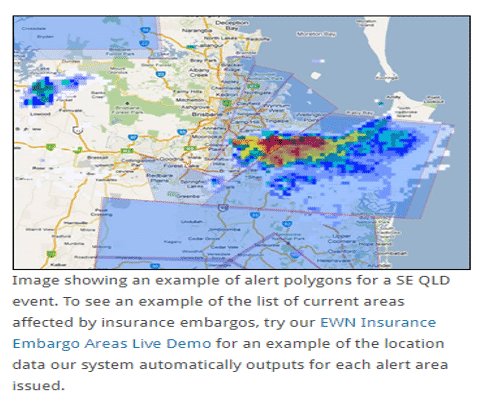
On the Early Warning Network website, it shows the areas where embargos are in place. As an example, it would look something like this.
1 - MCG Quantity Surveyors

In addition to this, I would suggest that using the ICA website is a good practice.

The Insurance Council of Australia has some great content on the website and will help you regarding finding an insurance underwriter that is willing to provide you cover even in an embargo.

In addition to this, they also provide data on the health and trends in the insurance market.

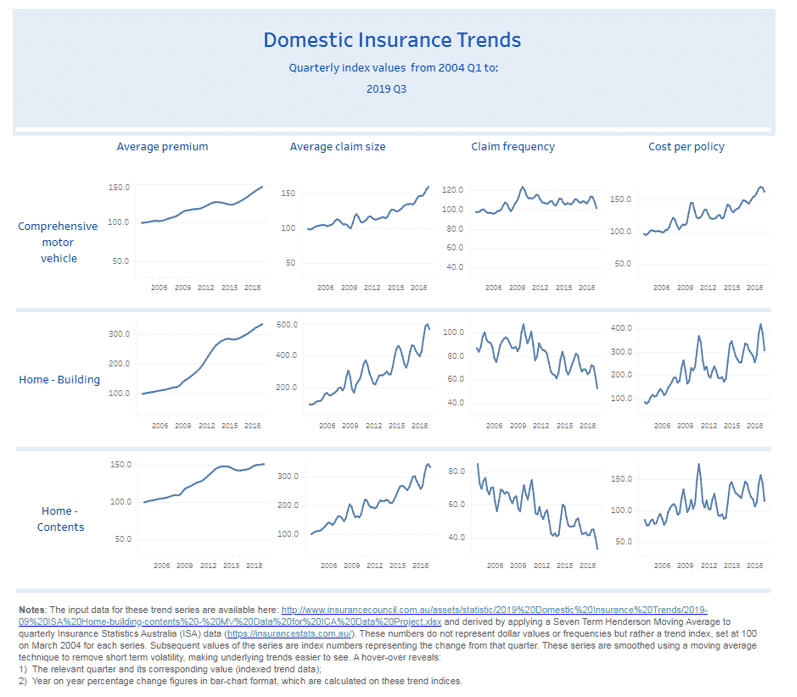
A snapshot of the Domestic Insurance Trends from 2002 Quarter 1 to 2019 Quarter 3, Is shown below:
2 - MCG Quantity Surveyors

You can see the average claim size for ‘Home – Building’ has been steadily increasing from well below the $200,000 mark in 2004 to now well over the $600,000 mark in 2019.

Either our homes are getting more expensive to build, or more of the house is being impacted in the event, moving more toward total loss rather than partial damage.

The next graph along from that is the claim frequency, which will after the most recent events of bushfires and floods be taking a hike northward.

Since the 8th November 2019 through to now, a reported by the Insurance Council of Australia, some 13,750 bushfire insurance claims have been lodged, totalling damages of $1.34 billion.

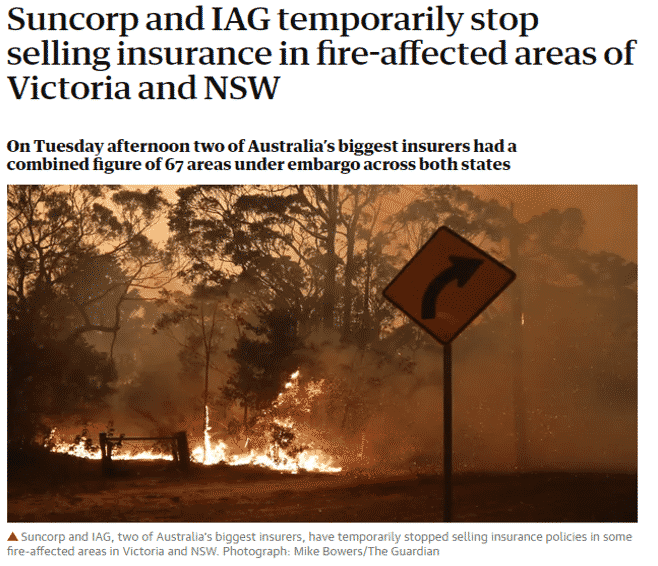
An article in the Guardian Newspaper as of around the 14th January 2019 this year, noted that both Suncorp and IAG, two of Australia’s biggest insurers had a combined 67 embargoed areas on their books.
4 - MCG Quantity Surveyors

I know I have been on my soapbox regarding underinsurance and inaccurate use of website calculators over the years, however, it seems that the industry just did not have a voice. It appears since my rants have become more public; the supporting voices are now coming out of the woodwork.

Like Jonathan Brown of the consumer group Choice.

“Like all insurance decisions, that’s entirely up to you. You need to carefully consider your own circumstances and look at independent advice beyond calculators provided by insurers and commercial brokers or websites”, says Jonathan Brown.

And now, even Campbell Fuller of the Insurance Council of Australia (ICA) has publicly announced on the ABC that:

“About 80% of insured property owners are probably under insured”, says Campbell Fuller of the ICA.

That was a direct quote from my last article on the inaccuracies of the online calculators within the industry. So, thank you, Mr Fuller.

For the residential property owner or homeowner, there is really two types of insurance that you can take out on your property.

  1. Total Replacement Cover, and
  2. Sum insured cover.

The sum insured value will cover you up to the set amount you choose to repair or rebuild your home.

So, in this circumstance, in my opinion, YOU MUST use the services of a quantity surveyor to determine what the rebuild cost will be.

However, Jonathan Brown of the consumer group Choice, further notes recently that:

“Some of the worst clauses allow insurers to base payouts on the rates they can purchase materials and labour at, rather than the actual cost of rebuilding or repairing your home”

“It may be worth considering a total replacement policy” Mr Brown says.

As I have said before, know your numbers. The fine print on policies do mean something and are worth your time.

Without being absolutely risk adverse on everything in life, I believe that from time to time, it is worth taking into account the worst that can happen in any particular scenario, then move backwards eliminating the risk or putting things in play to reduce the risk.

Let’s keep positive people, outstretch that arm and hand of your and help someone that could do with the help. It is not just property, lives and animals that were lost in the brutal bushfires recently. Communities have been as well. Let’s all do what we can. Travel to these affected areas, if nothing else, spend our money locally to them to help to rebuild these communities.